

Posted by Barb N.P. Team
on January 04, 2026

When it comes to treating marionette lines, my go-to recommendation is almost always a Hyaluronic Acid (HA) based dermal filler. Think of these as the gold standard in aesthetics—they have an incredible safety profile, deliver natural-looking results, and can even be dissolved if needed. They work by strategically restoring lost volume right where you need it, providing the structural support to soften those lines that run from the corners of your mouth down to your chin.
Understanding Your Filler Options for Marionette Lines
Marionette lines are those frustrating creases that frame the mouth, and they don’t just pop up overnight. They’re the result of a mix of factors: volume loss in the mid-face, loosening skin, and the inevitable pull of gravity. Dermal fillers tackle this head-on by replenishing that lost volume, giving us a powerful tool to create a smoother, more lifted look in the lower face. As an experienced Nurse Practitioner, I can't stress enough how critical the right filler choice is for achieving results that look balanced and completely natural.
While HA fillers are what we reach for most often, other options like Calcium Hydroxylapatite (CaHA) and Poly-L-Lactic Acid (PLLA) bring different strengths to the table. Understanding what makes each one unique is the first step toward creating a treatment plan that's truly tailored to you.
Key Filler Types at a Glance
Each category of filler has a different job. HA fillers offer immediate volume and a soft, natural feel. CaHA provides deeper structural support while giving your collagen a nice boost. And PLLA? That’s the long game—it works gradually to regenerate your body's own collagen for results that last.
"Choosing the best filler for marionette lines isn't about a single product; it's about matching the filler’s properties—like firmness and flexibility—to the patient's unique facial anatomy and aesthetic goals. A well-chosen filler should integrate seamlessly, supporting the skin without hindering natural expression."
— Barb, NP
The proof is in the results. A landmark multicenter clinical trial from 2023 confirmed what we see in the clinic every day: hyaluronic acid fillers showed remarkable long-term effectiveness for marionette lines, with an impressive 94.4% success rate 18 months after injection. This kind of data solidifies their spot as a top-tier choice for this common sign of aging. You can dive into more dermal filler statistics and findings on Elite Tampa.
To give you a clearer picture, here’s a quick breakdown of the main players before we get into the details of each one.
Quick Comparison of Fillers for Marionette Lines
This table offers a high-level look at the primary filler types, their core characteristics, and how they stack up for treating marionette lines.
| Filler Type | Primary Component | Best For | Typical Longevity |
|---|---|---|---|
| Hyaluronic Acid (HA) | Hyaluronic Acid | Immediate volume, fine-tuning, and natural feel | 9-18 Months |
| Calcium Hydroxylapatite (CaHA) | Calcium Microspheres | Deep structural support and moderate collagen boost | 12-18 Months |
| Poly-L-Lactic Acid (PLLA) | Poly-L-Lactic Acid | Gradual, robust collagen stimulation for global volume | 24+ Months |
As you can see, the right choice depends entirely on your specific goals—whether you’re looking for instant correction, structural lift, or long-term collagen building. Now, let’s explore what makes each of these options shine.
Understanding Why Marionette Lines Form
To find the best filler for marionette lines, we first need to understand why these stubborn creases show up. They aren't just surface-level wrinkles; they're the result of deep, structural changes happening under the skin as we age.
Think of your face like a building. Over time, its internal framework weakens, causing the exterior to sag and fold. Those lines that run from the corners of your mouth down to your chin are a classic sign that this process has begun, involving shifts in bone, fat, and skin all at once.
The Primary Culprits Behind Facial Aging
Marionette lines are driven by a few key anatomical shifts. Knowing what they are helps explain why dermal fillers are such a game-changer for treating them.
- Volume Loss: One of the biggest factors is the loss and downward shift of facial fat pads. As the supportive fat in our cheeks thins out, the skin above starts to droop, creating heaviness in the lower face that deepens those folds around the mouth.
- Collagen and Elastin Decline: These two proteins are the scaffolding of your skin, giving it firmness and bounce. After age 20, your body produces about 1% less collagen in the skin each year. This makes skin thinner and less resilient, so it’s more likely to crease under the pull of gravity and daily expressions.
- Bone Resorption: It’s not just your soft tissue that changes; your facial skeleton does, too. The jawbone can lose density and recede, which reduces the structural support for the lower face and chin.
This perfect storm of events—less support from below and more downward pressure from above—causes the skin to buckle and fold into the lines we see.
How Fillers Provide a Structural Solution
Now that we know the underlying causes, it's easy to see why just filling the line itself often isn’t the best strategy. A skilled injector understands that the real fix is restoring that lost structural support.
Fillers don't just "fill" a line; they rebuild the foundational support that has been lost. By strategically placing filler in areas like the cheeks and along the jawline, we can lift the sagging tissue, which in turn softens the marionette lines for a far more natural and balanced result.
This is why Hyaluronic Acid fillers are a go-to choice. They physically prop up the skin by replacing lost volume, smoothing the transition from the cheek to the chin. This approach targets the root cause—volume loss—instead of just putting a band-aid on the symptom.
To keep your skin healthy and get the most out of your filler treatments, at-home devices can be a huge help. The Barb N.P. LED Facial Mask is an excellent tool for this. Its wireless design is super comfortable and makes it easy to use regularly. The mask has three settings: red light to help stimulate collagen, blue light for targeting blemishes, and amber light to aid healing. It's the perfect way to support your skin’s health from the inside out and complement your professional treatments.
Comparing Hyaluronic Acid Fillers for Natural Results
When it comes to treating marionette lines, Hyaluronic Acid (HA) fillers are the gold standard. But here’s the thing: not all HA fillers are the same. Think of them less like a single product and more like an artist's toolkit—each one has unique properties designed for a specific job. An expert injector knows exactly which tool to pick to create a masterpiece.
The two key properties we look at are G-prime (its firmness or lifting power) and cohesivity (how well the gel holds together and flexes). A filler with a high G-prime is fantastic for providing structural support and lift, perfect for rebuilding a softening jawline. On the other hand, a filler with high cohesivity is more flexible, integrating beautifully into the skin and moving naturally with your expressions. My job is to perfectly balance these properties based on your skin, your anatomy, and what you want to achieve.
Juvéderm vs. Restylane: The Two Powerhouse Families
The conversation about the best filler for marionette lines almost always comes down to two industry giants: Juvéderm and Restylane. Both are exceptional HA filler families, but they’re built on different technologies, making them better suited for different needs.
- Juvéderm: Famous for its incredibly smooth, gel-like consistency. Many Juvéderm products use Vycross® technology, which creates a durable, efficient gel that feels soft, looks natural, and often lasts a bit longer.
- Restylane: This family is known for its XpresHAn Technology™, which produces more flexible gels. These fillers are engineered to move seamlessly with your facial expressions, making them a go-to choice for dynamic areas like around the mouth.
For a client with deep, etched-in marionette lines and good, thick skin, a firmer product like Juvéderm Vollure can be the perfect choice to provide the lift needed to soften the fold. But for someone with more superficial lines who is very expressive, a flexible filler like Restylane Defyne allows for completely natural movement without ever looking stiff or overdone.
The decision is never one-size-fits-all. It's a personalized prescription based on a deep understanding of how these products actually work within living tissue. You can learn more about the different options in our detailed guide on Juvéderm filler types.
Decoding Filler Properties for Your Needs
To really understand how a provider chooses the right filler, let’s walk through a common scenario. Imagine a patient comes in with moderate marionette lines and some sagging along the jaw. Just injecting filler directly into the lines would add weight and could actually make the downturned look worse.
A more strategic, expert approach would look something like this:
- First, we place a firm filler (high G-prime) like Juvéderm Voluma or Restylane Lyft along the jawline. This rebuilds the underlying structural support and literally lifts the lower face.
- Then, we use a softer, more flexible filler (high cohesivity) like Restylane Refyne directly in the marionette lines to smooth the remaining crease without restricting your natural smile.
This layered technique addresses the root cause of the problem—volume loss—while also refining the surface-level concern. The result? Incredibly natural-looking and effective.
Why Natural Movement is a Top Priority
One of the biggest fears my patients have is looking "done" or unnatural. This is where the advanced filler technology we have today really shines. The clinical data on Restylane, especially Refyne and Defyne with their XpresHAn technology, is particularly compelling.
Studies show an incredible 97% patient satisfaction in facial balance and 100% in harmony after treatment for marionette lines. Why? Because the technology is specifically designed to reduce skin strain and allow for natural movement, which is absolutely critical for a highly expressive area like the mouth.
It also helps to understand the science behind these amazing products. Most fillers utilize Sodium Hyaluronate, a key component in many dermal fillers, a salt form of HA that’s a superstar at helping the skin hold onto moisture and volume. It’s this fundamental science that makes these treatments so effective.
Ultimately, the best filler for your marionette lines is the one that's expertly chosen and skillfully placed to honor your unique beauty and expressions.
Exploring Radiesse and Sculptra for Collagen Stimulation
While Hyaluronic Acid fillers give a beautiful, immediate fix for marionette lines, some situations demand a different game plan. When you're dealing with more significant volume loss or skin laxity, the best approach isn't just about filling a line—it's about rebuilding the skin's underlying foundation. This is where collagen-stimulating fillers like Radiesse and Sculptra really shine.
Unlike HA fillers that simply add volume where they're placed, these products are biostimulators. Think of them as trainers for your skin. They work by kicking your body's own natural collagen production into high gear, leading to gradual, long-lasting improvements in skin quality, thickness, and structure. This makes them a fantastic choice for anyone seeking a subtle, progressive rejuvenation rather than an overnight change.
Radiesse: A Dual-Action Approach
Radiesse is made from Calcium Hydroxylapatite (CaHA) microspheres suspended in a smooth gel. Its unique formula gives it a powerful one-two punch that sets it apart.
First, the gel provides instant volume right after injection, much like an HA filler. You get an immediate lift and softening of those marionette lines. But the real magic happens over the next few months as your body naturally absorbs the gel carrier, leaving behind the CaHA microspheres. These tiny spheres create a scaffold that your cells use to build a fresh, strong network of new collagen.
The ideal Radiesse candidate often has deeper folds and could use more structural support along the jawline. Because it offers both immediate correction and long-term collagen growth, it perfectly bridges the gap between traditional fillers and pure biostimulators.
This dual-action mechanism means results can last 12 to 18 months, making it a durable and effective option for lower face rejuvenation.
Sculptra: The Gradual Collagen Builder
Sculptra is a completely different kind of player. Made of Poly-L-lactic Acid (PLLA), its primary job isn't to fill lines directly on the spot. Instead, Sculptra is a powerful collagen stimulator that works from the inside out to restore volume over time.
When injected, the PLLA microparticles trigger a controlled response that signals your body to ramp up new collagen production. The product itself is absorbed, but the new collagen it helps create remains, gradually thickening the skin and restoring youthful contours from within.
This is why a Sculptra treatment isn't a one-and-done procedure. It typically requires a series of 2-3 sessions spaced about a month apart to build up to the final, beautiful result, which unfolds over several months. The effects are incredibly natural-looking and can last for two years or more.
To help you visualize where different fillers fit, this decision tree clarifies when to use a firm filler for deep, static lines versus a more flexible one for dynamic expression lines.
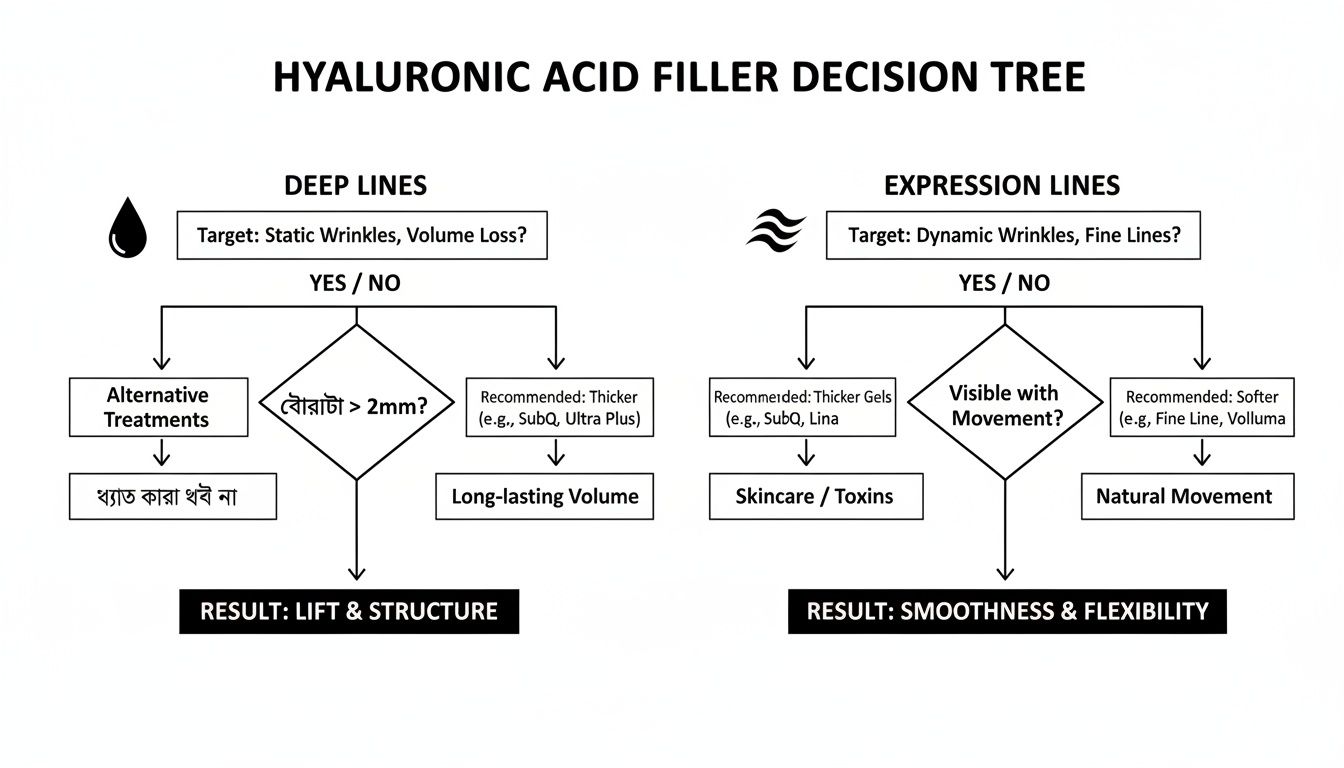
The key takeaway here is that the best treatment is highly personalized, matching the right product properties to the specific type of line we're addressing.
Detailed Filler Comparison: HA vs. CaHA vs. PLLA
Choosing the right filler category is the first step in creating a successful treatment plan. Each one has a unique mechanism of action and delivers results on a different timeline. This table breaks down the core differences between the three main types of dermal fillers used for facial rejuvenation.
| Feature | Hyaluronic Acid (HA) | Calcium Hydroxylapatite (CaHA) | Poly-L-lactic Acid (PLLA) |
|---|---|---|---|
| Composition | Sugar molecule gel that attracts water | Calcium-based microspheres in a gel | Synthetic, biodegradable polymer |
| Mechanism | Adds immediate volume and hydration | Provides immediate fill + stimulates collagen | Stimulates the body's own collagen growth |
| Placement | Superficial lines to deep structural support | Deeper planes for structure and lift | Diffuse injections for global volumization |
| Results Timeline | Immediate | Immediate lift, with collagen growth over 3-4 months | Gradual improvement over 4-6 months |
| Longevity | 6–18 months, depending on the product | 12–18 months | 2+ years |
Understanding these distinctions helps us tailor the treatment to your specific anatomy and aesthetic goals—whether you need instant gratification, structural support, or long-term skin thickening.
A great way to support any professional treatment is by promoting healthy skin at home. To learn more about stimulating rejuvenation from within, check out our guide on the best growth factors for skin, which can perfectly complement the collagen-boosting effects of these fillers.
Ultimately, a consultation with an experienced provider is essential to determine if a collagen-stimulating filler is the right call for your marionette lines. We can assess your facial structure and help you decide whether the immediate lift of Radiesse or the slow-building power of Sculptra aligns best with your aesthetic vision.
What to Expect During Your Filler Treatment
Deciding to treat marionette lines is a big step, so knowing exactly what happens during the appointment can make the whole experience feel more comfortable and empowering. We want to take the mystery out of the process, so you feel confident and prepared from the moment you walk through our doors.
The journey really begins before any needles are involved. Your consultation is the most important part—it's where we'll chat about your goals, go over your medical history, and create a treatment plan that’s right for you. This is our chance to decide on the best filler for marionette lines based on your unique facial structure and what you hope to achieve.

During the Appointment
Once we have a plan, the appointment itself is quick and easy, usually lasting less than an hour. Here’s what you can expect in the treatment room:
- Cleansing and Numbing: First, we'll thoroughly cleanse the area to ensure it's sterile. Then, we apply a topical numbing cream and let it sit for about 15-20 minutes. Your comfort is our top priority.
- Facial Mapping: Even with our initial plan, your injector will take a moment to re-evaluate your facial contours and mark the exact injection points. This careful planning is what creates balanced, natural-looking results.
- The Injection Process: Using an ultra-fine needle or a smooth, blunt-tipped cannula, we'll strategically place the filler. You might feel a tiny pinch or a bit of pressure, but most modern fillers contain lidocaine to minimize any discomfort.
For marionette lines, most patients need 1 to 2 syringes of filler, depending on how deep the lines are and how much volume we need to restore.
Post-Treatment and Aftercare
You'll see a difference right away, which is one of the best parts about filler treatments. It's completely normal to have a little swelling, tenderness, or redness at the injection sites, but these are temporary and usually fade within a few days.
Your aftercare is just as important as the treatment itself for ensuring the best possible outcome. Following your provider's instructions helps the filler settle correctly and minimizes potential side effects like bruising.
To get the most out of your treatment, we'll ask you to:
- Avoid strenuous exercise for the first 24 hours.
- Stay away from saunas, hot tubs, or excessive heat for a day or two.
- Try not to rub or massage the treated area.
The final, settled result will appear in about two weeks, once any swelling has gone down and the filler has fully integrated with your skin's tissue.
And the results speak for themselves. Recent studies on specialized HA fillers, like VYC-17.5 L, showed that 69.9% of participants saw a significant improvement in their marionette lines just one month after their treatment. It’s a great example of how quickly the right product can make a visible impact. You can learn more about these clinical findings and treatment efficacy online if you're curious.
Enhancing Your Results with a Holistic Approach
Finding the right filler for your marionette lines is a huge first step, but the secret to truly incredible, lasting results goes beyond what happens in the treatment room. The best outcomes come from a complete strategy—combining professional treatments with smart, supportive at-home care. It’s about looking at the big picture to ensure your filler looks fantastic and your skin stays healthy and strong.
One of my favorite ways to elevate filler results is by pairing it with a neuromodulator like Botox or Dysport. Marionette lines often get worse because of the constant downward pull from the Depressor Anguli Oris (DAO) muscles at the corners of your mouth. Just a tiny amount of Botox can gently relax these muscles, stopping them from pulling your mouth down and creating that unwanted sad or tired expression.
This duo is so effective because filler and Botox are solving two different problems. Filler adds back lost volume and provides that crucial structural support, while Botox releases the muscle tension that carves those lines deeper. Together, they give the lower face a much smoother, lifted, and naturally relaxed appearance.
Supporting Your Skin Health at Home
Think of your professional treatments as a major investment in yourself. Protecting that investment starts the moment you get home, with a daily routine that reinforces the results. Integrating advanced at-home devices and medical-grade skincare is key to maintaining your skin’s quality and getting the most longevity out of your filler.
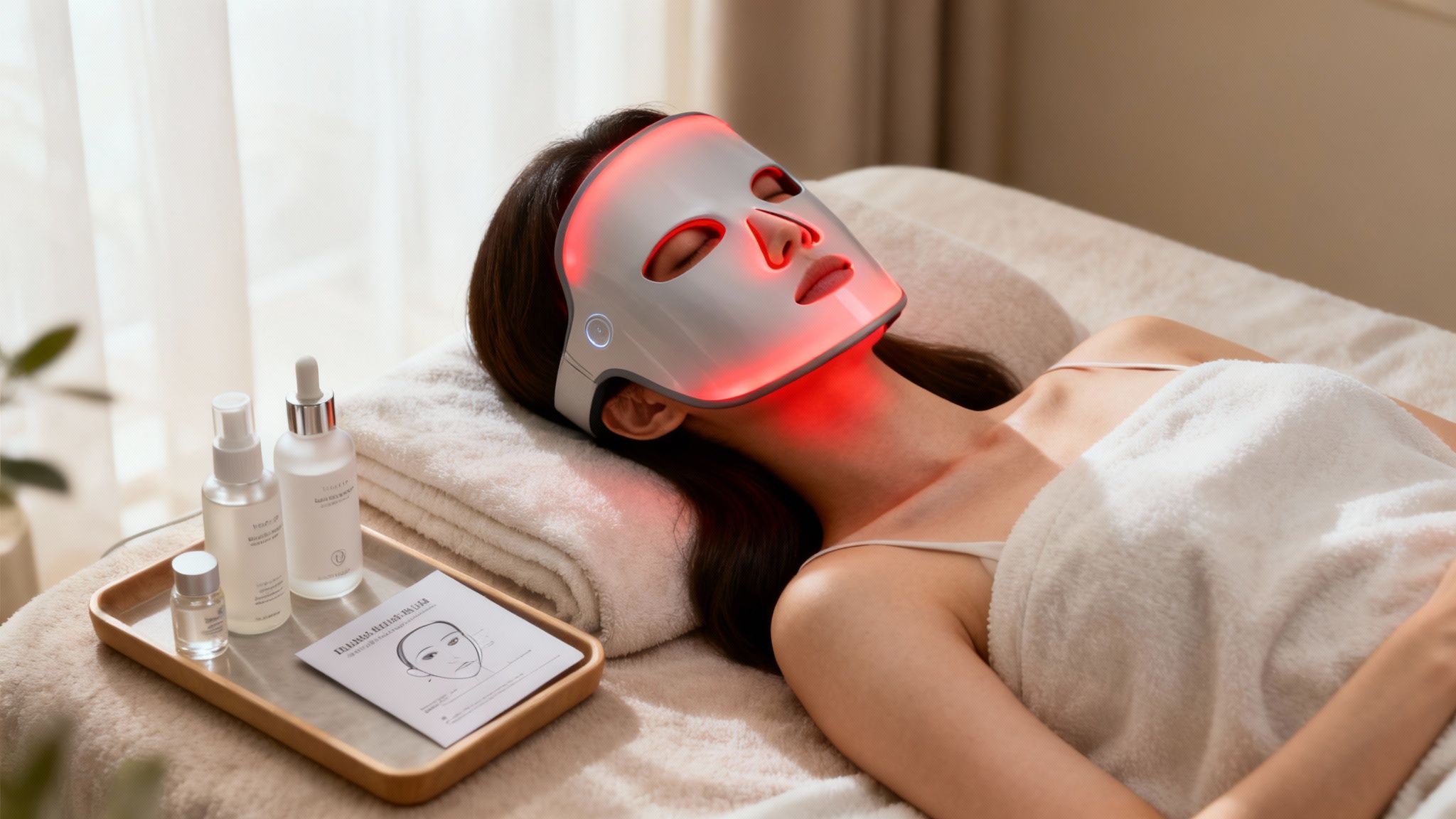
A fantastic tool for this is the Barb N.P. LED Facial Mask. This device brings the power of targeted light therapy right into your home, supporting your skin’s health on a cellular level. It’s the perfect partner to your in-clinic treatments.
For a comprehensive anti-aging strategy, consider red light therapy's benefits for skin health, which can enhance cellular repair and complement your filler treatments. This technology helps stimulate your skin’s natural rejuvenation processes.
The Barb N.P. mask was designed for real life. It’s completely wireless and comfortable, so you can easily pop it on while you relax, read, or move around the house. It has three targeted settings, each with a specific job:
- Red Light: This is your collagen-booster. It penetrates deep into the skin to wake up your fibroblast cells, which in turn amps up collagen production. Over time, this helps improve your skin’s firmness and elasticity.
- Blue Light: A lifesaver for anyone dealing with blemishes. It targets and neutralizes acne-causing bacteria to help clarify your complexion.
- Amber Light: Perfect for calming things down. It helps reduce redness and inflammation, promoting a more even skin tone and supporting the healing process.
Medical-Grade Skincare for Lasting Results
Finally, what you put on your skin every single day matters. A lot. Medical-grade skincare is formulated with higher concentrations of proven active ingredients that work to support your skin’s structure and health. A routine built around hydration, protection, and collagen support will help your filler last longer and keep your skin looking absolutely radiant.
Look for key ingredients like hyaluronic acid serums to lock in moisture, antioxidants like Vitamin C to fight off environmental damage, and retinoids to encourage cell turnover and collagen synthesis. And if you're curious about supporting this process from the inside out, check out our guide on natural ways to boost collagen.
When you combine expertly placed filler, a touch of neuromodulator, at-home light therapy, and a powerful skincare routine, you’re creating a complete ecosystem for rejuvenation. This multi-pronged approach ensures you aren’t just correcting marionette lines—you’re proactively investing in your skin’s long-term health for beautiful, lasting results.
Your Marionette Line Filler Questions, Answered
Deciding to get fillers often brings up a few practical questions. It's completely normal to wonder about the details, from comfort and cost to what to expect afterward. Here are the straightforward answers to the most common questions we hear from clients, so you can walk into your appointment feeling confident and fully prepared.
How Painful Are the Injections?
Most clients tell us the discomfort is minimal and very manageable. Your comfort is our top priority, which is why we always apply a strong topical numbing cream before starting.
On top of that, the high-quality hyaluronic acid fillers we use for marionette lines are formulated with lidocaine. This means the area stays numb throughout the injections. You might feel a tiny pinch or some light pressure, but the entire process is quick and easily tolerated.
How Many Syringes of Filler Will I Need?
This is the most common question, and the answer is always personal. It really depends on the depth of your lines, your unique facial structure, and your overall goals.
That said, a typical treatment for moderate marionette lines usually requires one to two syringes of filler. During your consultation, we'll do a complete assessment to figure out the exact amount needed to give you a beautiful, natural-looking lift without ever overfilling the area. The goal is subtle restoration, not a drastic change.
A common misconception is that more filler equals better results. For marionette lines, strategic placement is far more important than volume. An expert injector focuses on restoring support to lift the area, which often requires less product than patients expect.
Are the Results Immediate?
Yes, and it's one of the most satisfying parts of getting HA fillers! You'll see a noticeable improvement the moment you leave the clinic. The filler instantly adds volume to lift and smooth the treated area.
Keep in mind that you’ll likely have some minor swelling for a few days. Your final, settled result will be visible after about two weeks, once the filler has fully integrated with your tissue and any swelling has resolved.
What Is the Downtime After Treatment?
There’s virtually no downtime, which is why fillers are often called a "lunchtime treatment." You can head right back to your normal activities after your appointment.
We do recommend a few simple precautions to ensure you get the best possible outcome:
- Avoid strenuous exercise for 24 hours.
- Steer clear of excessive heat like saunas or hot yoga for a day.
- Refrain from drinking alcohol for at least 24 hours to minimize any potential bruising.
Following these simple aftercare steps helps the filler settle in perfectly and reduces the chance of extra swelling.
At BotoxBarb, we believe in enhancing your natural beauty with expert care and personalized treatment plans. Ready to smooth away your marionette lines and restore your confidence? Schedule your consultation with Barb N.P. today and discover the perfect filler solution for you.