

Posted by Barb N.P. Team
on December 27, 2025

If you're wondering, "how long does filler last?" the simple answer is usually somewhere between 6 to 18 months. But that's just a starting point. The reality is, there's no magic number. How long your gorgeous results last depends on the specific filler used, where it’s placed, and your own unique body chemistry.
Your Guide to Dermal Filler Timelines
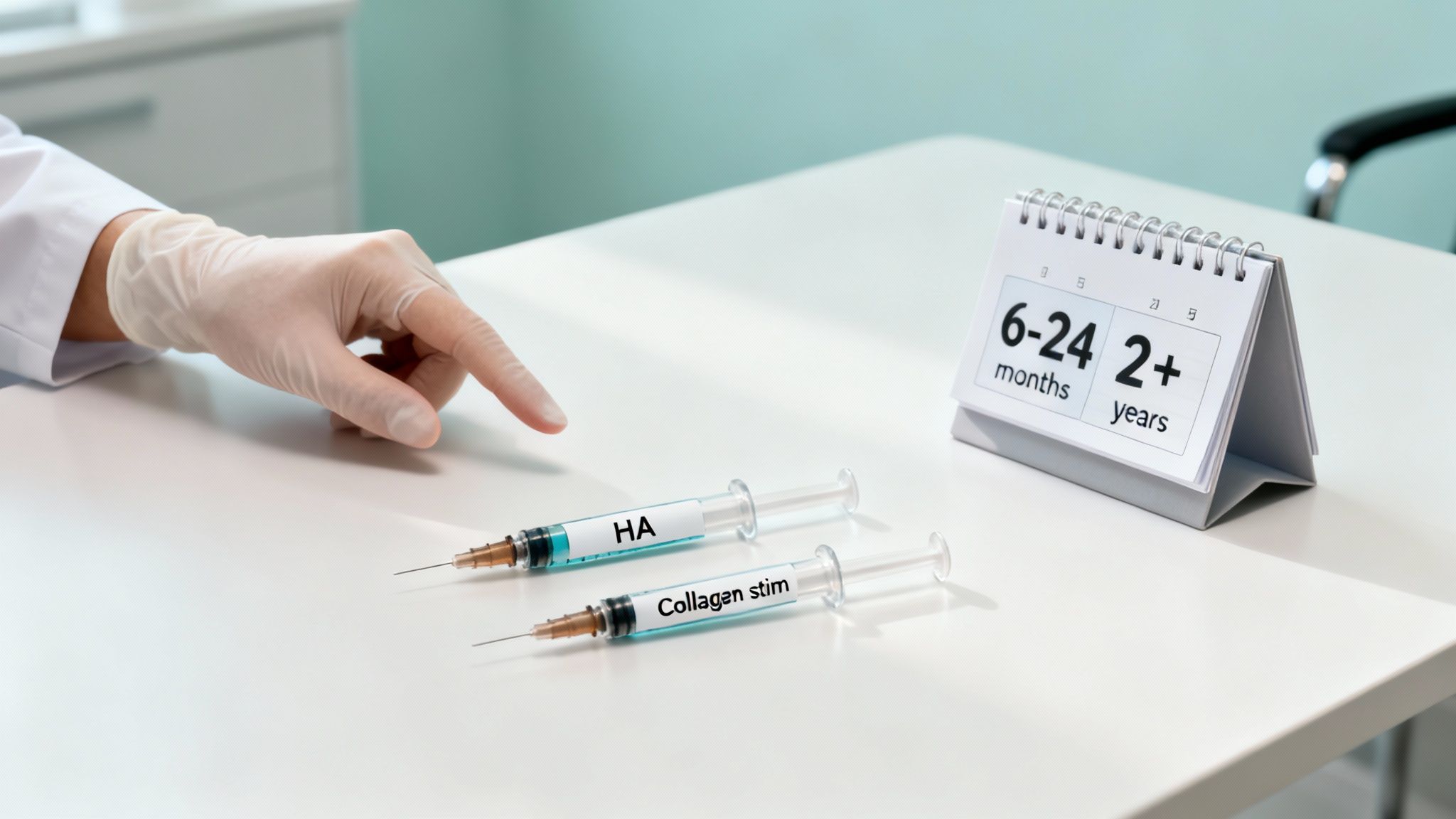
Welcome to your definitive guide on what to expect from your dermal fillers. Knowing the timeline is key to feeling confident in your aesthetic decisions and planning for the long term. Think of your results as a partnership—it’s a blend of your injector’s skill, the quality of the product, and your commitment to great aftercare.
This guide will give you a clear understanding of what to expect, from lip fillers that are constantly in motion to cheek fillers designed for sturdy, long-lasting support. We’ll get into all the factors that determine whether your results last closer to six months or beautifully extend beyond a year.
The Science Behind How Long Fillers Last
At its core, a filler’s lifespan comes down to its key ingredients and where we place it in the face. Most of the popular fillers, especially hyaluronic acid (HA) based ones like those we use at BotoxBarb, typically last 6 to 18 months.
But this varies quite a bit depending on the treatment area. For instance, lip fillers often last 6-12 months because our lips are so expressive and mobile. On the other hand, fillers placed in the cheeks can provide structure and volume for 12-24 months since that area has far less movement.
Think of it like this: A busy road with constant traffic (your lips) will show wear and tear much faster than a quiet side street (your cheeks). The same principle applies to how your body metabolizes filler over time.
It’s also smart to think about how your filler appointments fit into your overall beauty routine. For anyone who loves other treatments, knowing things like when to resume LED therapy after Botox or fillers is crucial for getting the best outcome from everything you do. Our goal at BotoxBarb is to give you the knowledge you need to build a seamless and effective aesthetic plan that works for you.
Understanding Different Types of Dermal Fillers
Not all fillers are created equal, and their core ingredients are the biggest factor in how long your beautiful results will last. Think of it like choosing the right material for a sculpture—some are designed for soft, immediate volume, while others are built to create a strong, lasting foundation. Getting to know the difference is the first step in setting the right expectations.
The most common and popular category by far is Hyaluronic Acid (HA) fillers. You’ve probably heard of the big names like Juvéderm and Restylane, which fall right into this group. Hyaluronic acid is a sugar molecule your body already makes, which is why these fillers are so incredibly safe and well-tolerated.
HA fillers are instant volumizers. They’re smooth, gel-like substances that use clever cross-linking technology—a process that links the HA molecules together—to restore volume and smooth away lines right before your eyes. Depending on the exact product and its consistency, results from HA fillers typically last anywhere from 6 to 24 months.
Hyaluronic Acid: The Versatile Volumizer
The real beauty of HA fillers is just how versatile they are. A thicker, more robust HA gel is perfect for creating deep structural support in the cheeks, giving you a lift that can last close to two years. On the other hand, a softer, more flexible gel is the go-to for lips, where natural movement is constant; these tend to last around 6 to 12 months.
This adaptability is what allows an expert injector like Barb N.P. to hand-pick the perfect product for each unique area of your face. If you're curious about the science behind it all, our guide on how dermal fillers work breaks down the mechanics beautifully. It really clarifies why one filler is ideal for your smile lines while another is better suited for sculpting your jawline.
Collagen Stimulators: The Long-Term Builders
Now, let's look beyond instant volume. The second major category is collagen-stimulating fillers. Products like Sculptra (poly-L-lactic acid) and Radiesse (Calcium Hydroxylapatite) operate on a completely different principle. Instead of just filling a space, they act like tiny "seeds" planted beneath the skin.
These biostimulators kickstart your body’s own natural collagen production. This means your results emerge more gradually over a few months as your skin literally rebuilds its own support structure from the inside out. The final result is incredibly natural-looking and impressively long-lasting.
Because they encourage your body to do the heavy lifting, collagen-stimulating fillers like Sculptra are known to outlast traditional HA options, with results that can persist for two years or even more. Radiesse, another powerful choice, often lasts between 12 to 24 months, providing both an immediate lift and long-term collagen benefits.
This extended timeline is a huge reason why a provider might recommend one. For a deeper dive into how these fillers stack up, you can discover more insights about filler duration from Direct Aesthetics.
At-Home Care to Support Your Results
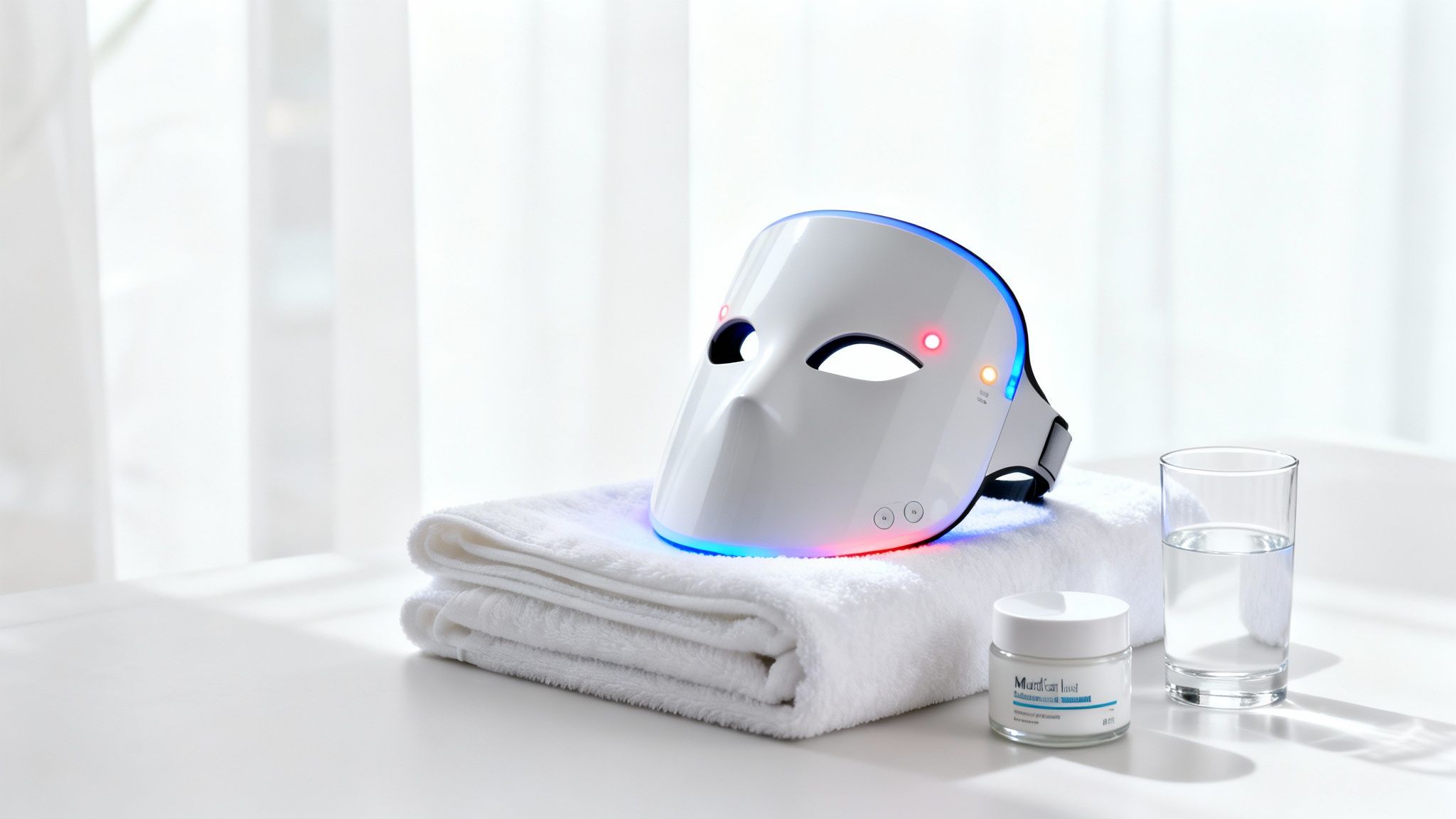
No matter which filler you choose, supporting your skin's health is the secret to getting the most out of your investment. One of the best ways to do this is by incorporating advanced treatments at home, and the Barb N.P. Facial Mask is the perfect companion to your in-clinic procedures.
This device offers a convenient and powerful way to boost your skin's health between appointments. Here's what makes it a standout:
- Wireless Design: Move around freely during your treatment without being stuck next to an outlet.
- Comfortable Fit: It’s designed to rest easily on your face, turning your self-care session into a truly relaxing experience.
- 3 Light Settings: It includes red light to stimulate collagen, blue light to fight acne bacteria, and amber light for overall rejuvenation.
Using tools like this LED mask helps maintain the quality and health of your skin. You’re essentially creating the best possible environment to support and extend the beautiful results of your dermal fillers.
How Treatment Area Impacts Filler Duration
When it comes to filler, where it’s placed is just as important as what it’s made of. It’s one of the biggest factors in determining how long your beautiful results will last.
Think of your face as a map with high-traffic highways and quiet residential streets. The longevity of your filler all comes down to which neighborhood it lives in. This is a core principle we use at the clinic to set realistic expectations and craft a treatment plan that truly works for you.
This simple diagram breaks down the different types of fillers we work with, from the popular hyaluronic acid (HA) gels to collagen-builders like Radiesse and Sculptra.
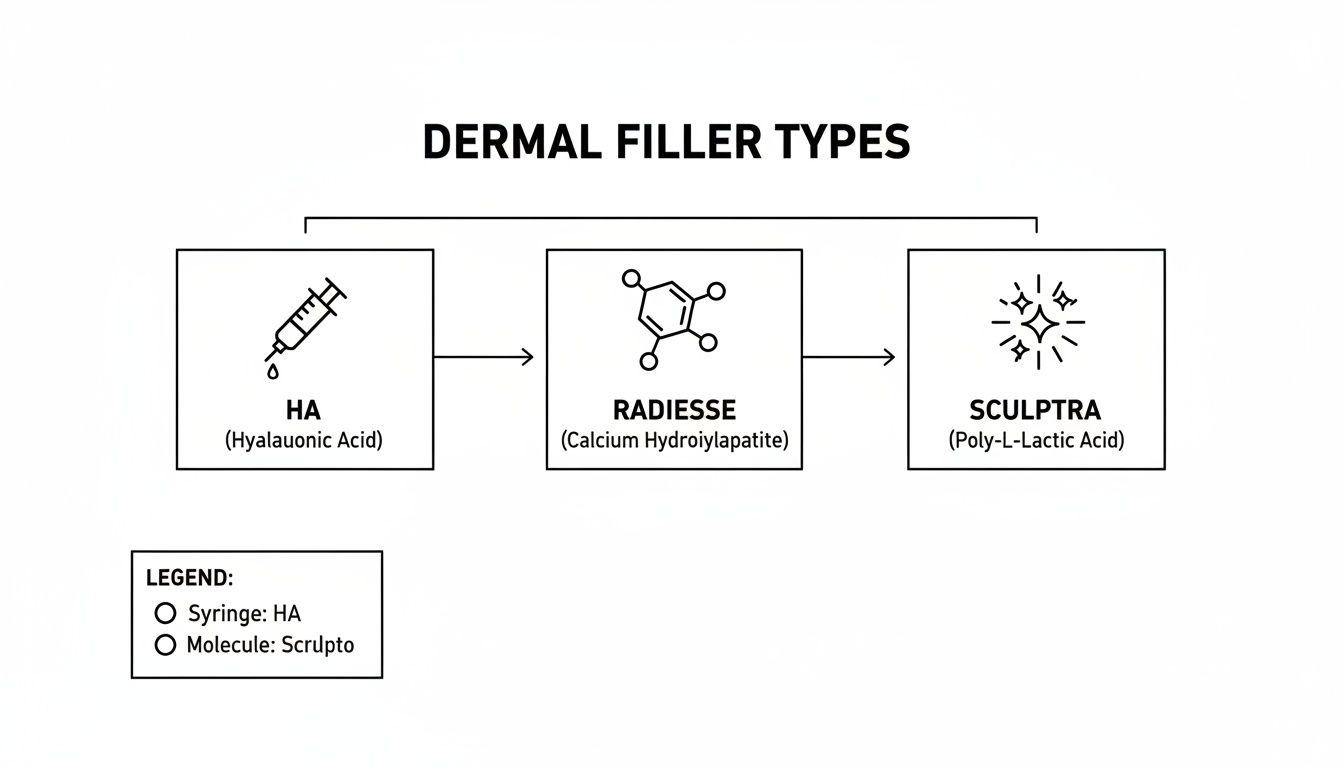
While each of these materials has unique properties, they are all affected by the amount of movement in the area they’re placed.
High-Motion Areas: The Well-Traveled Roads
Some parts of your face are constantly on the move. Your lips, the lines around your mouth (nasolabial folds), and the creases around your eyes are all what we call high-motion zones.
Every time you smile, talk, eat, or laugh, the muscles in these areas are hard at work, putting constant stress on the filler. This activity speeds up your body's natural process of breaking down the product, meaning fillers in these dynamic spots tend to have a shorter lifespan.
- Lips: Lip filler is a perfect example. All that talking and eating means the product metabolizes faster here than almost anywhere else. You can typically expect results to last between 6 to 12 months.
- Smile Lines (Nasolabial Folds): Filler used to soften the lines running from your nose to the corners of your mouth also sees a lot of daily movement. Results here generally last around 9 to 12 months.
Low-Motion Areas: The Quiet Side Streets
Now, let's head to the quiet neighborhoods. Areas with very little muscle movement—like the cheeks, temples, and under-eyes—are considered low-motion zones.
Because there's not much activity, the filler can settle in, integrate with your tissue, and provide stable, long-lasting structure. It isn't being constantly broken down by muscle contractions.
For instance, cheek fillers are one of the longest-lasting treatments we offer. Since the mid-face is relatively static, a robust hyaluronic acid filler can lift and contour for an impressive 12 to 24 months—sometimes even longer.
This makes it an incredible option for restoring youthful volume that has been lost over time. To learn more about why this treatment is so effective, check out our guide on the best fillers for cheeks.
To make this concept even clearer, here’s a quick comparison of how filler longevity differs across the face based on movement.
Comparing Filler Longevity: High-Motion vs. Low-Motion Areas
This table breaks down how much facial movement really matters for your filler’s lifespan.
| Area Type | Example | Primary Function | Expected HA Filler Lifespan | Reason for Longevity |
|---|---|---|---|---|
| High-Motion | Lips | Expression, eating, talking | 6–12 months | Constant muscle activity breaks down the product faster. |
| High-Motion | Smile Lines | Smiling, facial expressions | 9–12 months | Frequent movement accelerates the metabolic process. |
| Low-Motion | Cheeks | Structural support | 12–24 months | Minimal movement allows the filler to remain stable. |
| Low-Motion | Under-Eyes | Filling hollows | 12–18 months | Delicate area with little dynamic motion. |
| Low-Motion | Temples | Volume restoration | Up to 24 months | Very static area, allowing for maximum duration. |
As you can see, the less an area moves, the longer you can expect your filler to last. It’s a simple but powerful principle.
Other Key Treatment Zones
Beyond the major areas, other spots have their own timelines based on their unique anatomy and function.
Here are a few more common treatment zones and what you can typically expect:
- Under-Eyes (Tear Troughs): This is a delicate, low-motion area, so fillers can last quite a while here. Expect results to give you a refreshed, less-tired look for 12 to 18 months.
- Jawline and Chin: These areas add definition and structure. While there's some movement from talking, it's far less than the lips. Fillers here often last 12 to 18 months, helping sculpt a sharper lower face.
- Temples: Just like the cheeks, the temples are a static area. Restoring lost volume here provides a subtle lift, and results can last for a long time—often up to 24 months.
Ultimately, choosing the right filler for the right location is a strategic decision your injector makes. By pairing your facial anatomy with your goals, an experienced provider like Barb N.P. can achieve results that are not only stunning but also beautifully long-lasting.
Personal Factors That Affect Your Results
While the filler we choose and the area we treat set the baseline, they don't tell the whole story. Your own biology and daily habits are the real co-stars here, playing a huge role in how long your investment lasts. Think of filler as a guest in your body—how long it stays really depends on the environment you create for it.
Getting a handle on these personal factors is the key to understanding how long filler will really last for you. Some of us just naturally break things down faster, and certain lifestyle choices can either protect your results or unfortunately, speed up their decline.
Your Metabolism and Activity Level
Your metabolism is basically your body's engine, breaking down everything from your last meal to, yes, your dermal filler. If you have a naturally fast metabolism—the kind that lets you eat whatever you want—your body will probably process and dissolve hyaluronic acid fillers more quickly than someone with a slower metabolic rate.
This is especially true for athletes and anyone who is highly active.
- Intense Exercise: Regular, high-intensity workouts crank up your metabolic rate and blood flow, which can accelerate how fast your body breaks down filler.
- Active Lifestyles: If you’re a fitness instructor, a marathon runner, or just someone who is always on the go, you might find your fillers don’t last quite as long as the typical estimates.
This absolutely doesn't mean you should give up your workouts! It just means we need to be realistic and may plan for slightly more frequent touch-ups to keep your results looking fresh.
The Impact of Your Lifestyle Choices
Beyond your natural metabolism, your daily habits have a direct and powerful effect on your skin's health and the durability of your filler. Think of it this way: certain choices create an environment that actively works against your results.
Smoking and frequent, unprotected sun exposure are the two biggest culprits. Both unleash a flood of free radicals—unstable molecules that attack and degrade not only the hyaluronic acid in your filler but also your body's own natural collagen and elastin.
This process, known as oxidative stress, essentially chips away at the very structures keeping your skin firm and your filler stable. Someone who smokes or tans regularly might see their results fade 20-30% faster than a non-smoker who is diligent with SPF. Protecting your investment goes far beyond what happens in the treatment room.
Protecting Your Investment with a Holistic Approach
The great news is that you have a ton of control over preserving your filler. A balanced lifestyle and a dedicated skincare routine are your best defense, acting like a shield to maintain your results for as long as possible.
A holistic approach is everything. This includes:
- A Nutrient-Rich Diet: Eating foods high in antioxidants—think berries, leafy greens, and nuts—helps your body fight off that free radical damage from the inside out.
- Staying Hydrated: Hyaluronic acid loves water. Drinking plenty of fluids helps the filler particles stay plump and effective, which contributes to a better, longer-lasting result.
- Consistent Sun Protection: Using a broad-spectrum sunscreen with at least SPF 30 every single day is non-negotiable. This is the single most effective thing you can do to protect your skin and your filler from UV damage.
This is where a medical-grade product can make all the difference. We highly recommend the Barb N.P. Sheer Physical SPF 50, a mineral-based sunscreen that provides powerful, transparent protection without feeling heavy or greasy. Making a high-quality SPF like this a non-negotiable part of your daily routine is a simple step that pays huge dividends in extending the life of your filler.
When you take care of your overall wellness, you’re also taking the best possible care of your aesthetic results.
How to Extend the Life of Your Fillers
You’ve invested in your appearance and love the results. Now, how do you protect that investment? Making your filler last as long as possible is about more than what happens in the treatment chair; it’s a smart blend of immediate aftercare and smart long-term maintenance.
With just a few key strategies, you can significantly extend the life of your beautiful, natural-looking results.
The first 48 hours after your appointment are the most critical. During this window, the filler is settling into place, so your job is to create the perfect environment for it to integrate seamlessly with your own tissue. Think of it like letting high-quality cement set—you wouldn’t disturb it while it’s still curing. The same principle applies here.
Following a few simple but powerful rules right away ensures your results stabilize perfectly from the start.
Crucial Aftercare for the First 48 Hours
Your injector will give you a detailed list of instructions, but these are the universal guidelines to maximize longevity right out of the gate. Following these steps helps prevent unnecessary swelling and ensures the filler stays exactly where it was masterfully placed.
- Avoid Strenuous Exercise: Getting your heart rate and blood flow way up can worsen swelling and potentially interfere with how the filler settles. Stick to light activities like walking for the first day or two.
- Steer Clear of Extreme Heat: Saunas, steam rooms, hot tubs, and even super-hot showers can increase blood flow to the face. It’s best to avoid them for at least 24 hours.
- Skip Alcohol: Alcoholic drinks can thin the blood, increasing the risk of bruising and swelling. It’s wise to hold off for at least a day post-treatment.
- Minimize Touching: As tempting as it is, resist the urge to press, massage, or manipulate the treated areas. Let the filler settle naturally.
These immediate steps lay the foundation for long-lasting success, helping you get the most out of every single treatment.
Long-Term Maintenance with Medical-Grade Skincare
Once that initial settling period is over, your focus shifts to long-term preservation. This is where a high-quality, medical-grade skincare routine becomes your most powerful ally.
Your daily habits directly impact how long your filler lasts by protecting your skin from the environmental damage that breaks down both the filler itself and your own natural collagen.
The single most important step? Daily sun protection. UV radiation creates free radicals that degrade hyaluronic acid and speed up the aging process. Using a broad-spectrum sunscreen with an SPF of 30 or higher is completely non-negotiable.
Beyond that, incorporating products with antioxidants like Vitamin C helps neutralize free radical damage, while a good hydrator keeps the skin plump and supports the water-loving HA molecules in your filler. This proactive approach is fundamental to the BotoxBarb philosophy of achieving—and maintaining—lasting confidence.
Enhance Your Results with Advanced At-Home Care
Ready to take your maintenance to the next level? Integrating professional-grade tools into your home routine can make a remarkable difference. This is how you can actively support your skin’s health between appointments, creating the ideal environment for your filler to thrive.
For this, we highly recommend the Barb N.P. Facial Mask. This device is designed to perfectly complement your in-clinic treatments, offering a powerful way to boost skin health and support your collagen framework.
The Barb N.P. Facial Mask is a game-changer for at-home care. Its wireless, comfortable design makes it easy to use while you relax, read, or move around your home. You’re not tethered to a wall, which makes consistent use feel effortless.
It’s equipped with three distinct, powerful light settings, each targeting a different concern to give you a comprehensive treatment:
- Red Light: This setting is phenomenal for stimulating collagen production. By supporting your skin’s underlying structure, it helps maintain firmness and enhances the longevity of your filler. If you're looking for other ways to support your skin's foundation, you can learn about some natural ways to boost collagen in our detailed guide.
- Blue Light: Perfect for those concerned with blemishes, this light setting effectively combats acne-causing bacteria, promoting a clearer, healthier complexion.
- Amber Light: This setting focuses on overall rejuvenation. It helps reduce redness and promotes a more even skin tone, giving you a radiant glow.
By combining professional treatments with advanced home care like this LED mask, you create a powerful synergy that extends and enhances your results, keeping you looking refreshed and confident for months to come.
Knowing When It’s Time for a Touch-Up
One of the best things about modern dermal fillers is how gracefully they fade. They don’t just vanish overnight. Instead, the effects soften slowly and subtly over time, gradually returning you to your natural baseline. The real secret to seamless, long-term results is learning to spot the early signs that your filler is metabolizing.
This isn’t about starting over from scratch. It’s about maintaining the beautiful foundation we’ve already built. A touch-up appointment is designed to keep your look consistent and natural, often requiring less product than your very first treatment. Think of it as maintenance, not a complete redo.
Recognizing the Subtle Cues
Learning to see the early signals for a maintenance visit puts you in control. Your face will give you gentle clues that it might be time to schedule an appointment with Barb N.P. If you’re observant, you can book a touch-up long before your results have fully faded away.
Keep an eye out for these specific, subtle changes:
- Gentle Return of Lines: Those fine, static lines that were once smooth might start to reappear, but very faintly.
- Slight Volume Reduction: Areas like your cheeks might look a little less lifted or softly contoured than they did a few months ago.
- Less Definition: You might notice the crisp border of your lips has softened, or that sharp angle along your jawline seems a little less defined.
- Shadows Reappearing: Subtle hollows or shadows, especially under the eyes, may start to become slightly more prominent again.
These aren't dramatic shifts but quiet reminders that your body is naturally and safely processing the filler. Catching them early is the key to effortless upkeep.
A maintenance appointment is like topping off a reservoir rather than refilling an empty one. By scheduling touch-ups when you’re at 50-60% of your initial result, you maintain a consistent look and often use less product over time, making it a more efficient and cost-effective strategy.
Designing Your Long-Term Plan
The filler world has come a long way since the first HA products like Juvederm got FDA approval back in 2006. We’ve seen incredible advancements, like Allergan's Vycross technology, which has pushed the longevity of cheek fillers from a standard 6-18 months to an impressive 12-24 months.
The industry continues to evolve, with the dermal filler market projected to grow from USD 6.6 billion in 2025 to 9.0 billion by 2035. This growth is built on a foundation of safety, affirmed by incredibly low rates of long-term adverse events. You can dive deeper into the evolution and safety of HA fillers in detailed clinical reviews.
What this progress means for you is that your long-term plan is more customizable than ever. The best next step is to schedule a consultation with Barb N.P. to design a maintenance schedule that fits your specific goals, the products we used, and your unique lifestyle. Together, we’ll create a proactive plan to keep you looking and feeling your confident best.
Your Top Questions About Filler Longevity
At the clinic, we talk about fillers all day, and some questions come up more than others. To help you feel completely confident and informed, we've put together quick, clear answers to the things our clients ask most about how long their results will really last.
Can I Make My Lip Filler Last Longer?
Absolutely. While it’s true that the lips are a high-motion area, there are definitely things you can do to help your results go the distance. First, stay hydrated! Hyaluronic acid fillers love water, so drinking plenty helps maintain that plumpness.
It’s also smart to avoid smoking and protect your lips from sun damage with a quality SPF lip balm. Little things, like following our post-care advice to avoid straws for the first 24-48 hours, also make a big difference in letting the filler settle perfectly. For truly consistent volume, though, the secret is regular, small touch-up appointments.
Does Injector Technique Affect How Long Filler Lasts?
Yes, this is one of the most important factors. An injector’s skill is paramount to both the beauty and the longevity of your results. An experienced provider like Barb N.P. has a deep, nuanced understanding of facial anatomy and knows exactly where to place filler—at the right tissue depth—for the best outcome.
Proper injection technique isn't just about avoiding bumps; it minimizes the risk of product migration and ensures the filler integrates beautifully with your own tissue. This stability is the key to achieving that natural, gorgeous, and long-lasting result everyone wants.
Will My Face Look Strange After Filler Wears Off?
This is a very common myth, but the answer is a firm no. Your body naturally and safely metabolizes hyaluronic acid filler over time. As it does, your face will simply and gradually return to how it looked before treatment.
You won't look worse, deflated, or saggy. In fact, because some fillers stimulate your body to produce a little of its own new collagen, you might even notice a subtle, lasting improvement in your skin’s overall texture long after the filler is gone.
How Often Should I Get Touch-Ups?
The perfect touch-up schedule really depends on you—the specific filler we used, the area we treated, and your personal aesthetic goals. For high-movement areas like the lips, we might suggest a touch-up every 6-9 months to keep them looking perfect.
For more static areas, like the cheeks or jawline where the filler isn't disturbed as much, you might go 12-18 months between appointments. The best approach is to schedule a follow-up with Barb N.P. when you start to notice the effects gently softening. A proactive maintenance plan is always more effective and often requires less product in the long run.
At BotoxBarb, our focus is on creating personalized treatment plans that deliver beautiful, lasting results. To support your skin's health at home and complement your in-clinic treatments, explore our curated selection of medical-grade skincare, including the rejuvenating Barb N.P. Facial Mask. Visit the shop today to discover your perfect routine.