

Posted by Barb N.P. Team
on January 08, 2026

When it comes to softening those stubborn marionette lines, not just any filler will do. We’re typically reaching for robust hyaluronic acid (HA) formulas like Juvéderm Vollure XC, Restylane Refyne, and Restylane Defyne. These are the workhorses of the filler world, specifically engineered to give you the structural support needed to lift deep creases while still being flexible enough for natural, expressive movement. An experienced injector will select the perfect one based on the depth of your lines and your unique facial structure.
Understanding Fillers for Marionette Lines
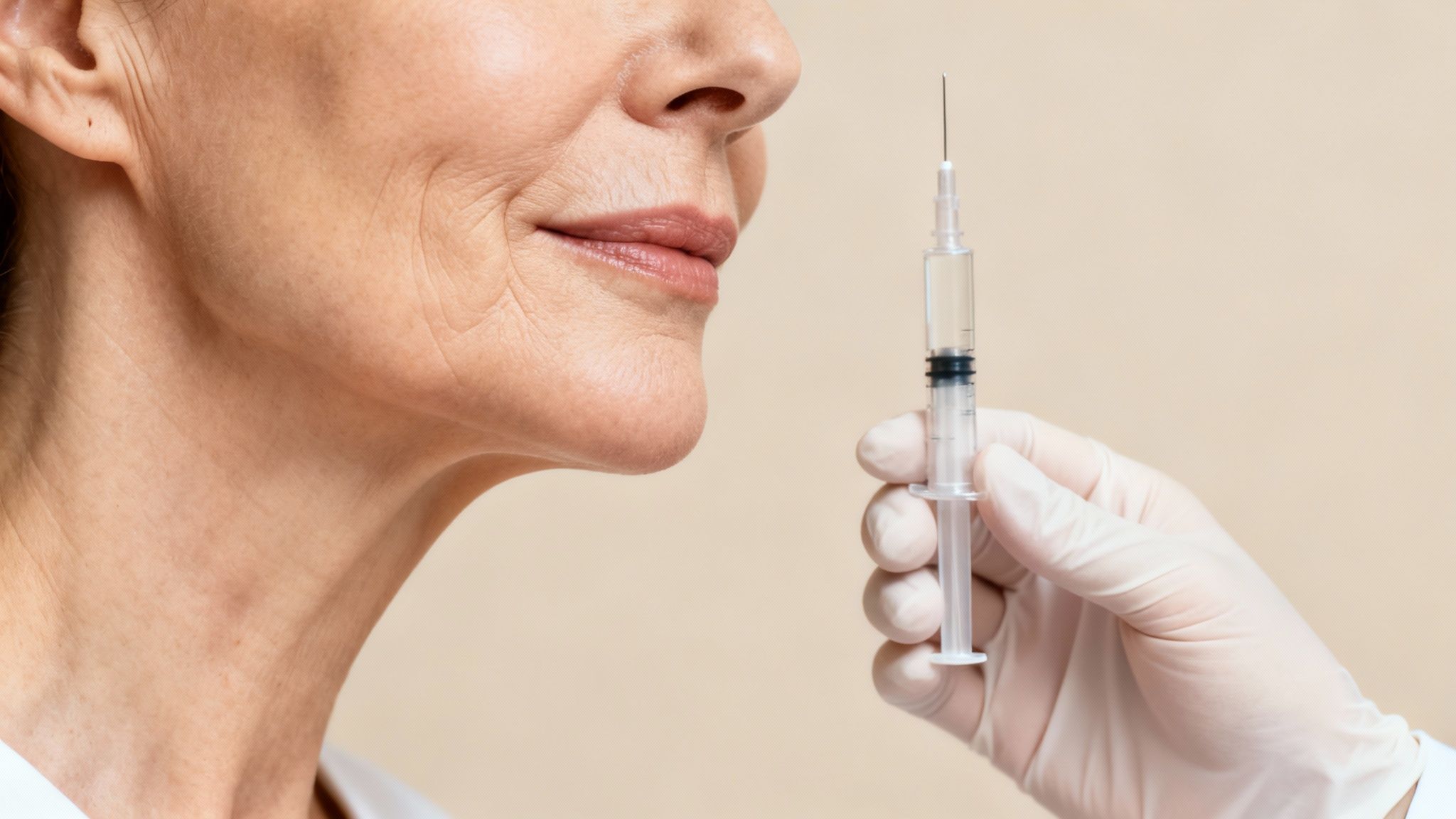
Marionette lines—those creases that run from the corners of your mouth down to your chin—are one of the most common signs of aging. They pop up thanks to a combination of factors: lost facial volume, a natural decrease in skin elasticity, and a lifetime of facial expressions. Dermal fillers are a powerful, non-surgical solution because they get right to the root of the problem: volume loss.
These cosmetic injectables work by placing a specialized gel just beneath the skin's surface. This restores support, effectively "filling in" the crease and smoothing the entire area. The most trusted fillers for this are made from hyaluronic acid (HA), a substance your skin produces naturally to stay hydrated and plump.
Why Hyaluronic Acid Fillers Are the Top Choice
Hyaluronic acid fillers are the gold standard for treating marionette lines for a few key reasons. First, they're biocompatible, which means your body accepts them easily. They're also reversible, which is a crucial safety net that gives patients peace of mind.
An experienced provider like Barb N.P. can precisely select and place an HA filler to not only soften the marionette lines but also provide subtle structural support to the lower face, creating a more lifted and refreshed appearance.
Different HA fillers have unique personalities. Some are softer and more flexible, perfect for fine lines, while others are firmer and provide more significant lift for deeper folds. This guide will walk you through the leading options so you know exactly what to discuss during your consultation.
| Filler Type | Key Characteristic | Best for Marionette Lines? |
|---|---|---|
| Hyaluronic Acid (HA) | Reversible, natural-feeling, versatile | Yes, the leading choice for safety and efficacy. |
| Calcium Hydroxylapatite | Provides significant lift, stimulates collagen | Can be used, but often for deeper structural support. |
| Poly-L-lactic Acid | Gradual, collagen-stimulating results | Less common for direct line filling, more for area volumizing. |
Ultimately, choosing the right filler comes down to a detailed consultation where your injector assesses your facial anatomy and aesthetic goals. This guide gives you the foundational knowledge you need for that conversation, empowering you to make a confident decision on your journey to smoother, more youthful contours.
How Dermal Fillers Soften Marionette Lines and Restore Your Smile
When you see marionette lines, what you’re really seeing is a loss of volume and support in the lower face. Dermal fillers are designed to address this problem head-on. By carefully injecting a smooth, gel-like substance beneath the skin, an experienced provider can physically lift those sunken areas, softening the shadows and folds that pull down the corners of your mouth.
The result isn't just about erasing lines—it's about restoring the natural, gentle curves of a youthful face.
The science behind this is elegant, and it almost always comes back to one powerhouse ingredient: Hyaluronic Acid (HA). HA is something your body already produces to keep skin hydrated and plump. HA fillers use a specialized, lab-created version of this molecule to give back the volume that time has taken away, providing structure that feels completely natural.
The Art and Science of Choosing the Right Filler
Not all HA fillers are the same. A skilled injector thinks like an artist, and the fillers are their palette. For an area like the mouth that moves constantly when you talk and smile, two properties are absolutely critical: G-prime and cohesivity.
-
G-Prime (Firmness): Think of this as the filler's "lifting power." A higher G-prime means a firmer gel capable of providing strong structural support. This is exactly what’s needed to prop up a deep fold or a downturned corner of the mouth.
-
Cohesivity (Flexibility): This is all about how well the gel holds together and moves with you. A filler with high cohesivity integrates seamlessly into your tissue, so your smile looks smooth and natural, not stiff or lumpy.
For marionette lines, the magic is in the balance. You need a filler that’s firm enough to lift but flexible enough to bend and flex with every expression. This is the secret to achieving the best dermal fillers for marionette lines—results that look great both at rest and in motion.
The goal isn't to erase every line but to restore the gentle, youthful curves of the lower face. A skilled injector uses these filler properties like an artist uses different paint brushes, selecting the right tool to create a soft, natural, and refreshed appearance.
Why HA Fillers Are the Gold Standard
There’s a reason HA fillers dominate the market, especially for marionette lines. It comes down to safety and reliability. They are biocompatible, meaning your body accepts them readily. But most importantly, they’re reversible. If for any reason you’re not happy with the result, an enzyme called hyaluronidase can be injected to dissolve the filler. This is a huge safety net, especially for anyone new to injectables.
HA fillers like those in the Restylane family are the go-to choice for practitioners worldwide. They have a proven track record for safety, predictable results, and longevity. Most studies and clinical analyses show that corrections in the marionette line area typically last 12–18 months. Better yet, HA fillers don’t just add volume—they also improve skin elasticity and can even stimulate your own collagen production over time. This is a huge advantage for tackling marionette folds, which are often made worse by age-related skin laxity.
This dual-action benefit—filling and rejuvenating—is what makes HA fillers such a powerful tool. They don’t just put a band-aid on the problem; they help improve the tissue from within. To get a deeper look at how this works, you can read our guide on how dermal fillers work.
Ultimately, knowing a little about the science empowers you to have a better, more collaborative conversation with your provider. When you discuss options like Juvéderm or Restylane, you’ll understand that the decision comes down to finding that perfect blend of firmness and flexibility for your unique anatomy.
Comparing Juvéderm and Restylane for Marionette Lines
When you start researching the best dermal fillers for marionette lines, two names will pop up again and again: Juvéderm and Restylane. They're both top-tier brands using hyaluronic acid (HA), but they get their gorgeous results in very different ways. Knowing these differences is what empowers you to have a really productive conversation with your provider about which one is truly right for you.
The choice isn't as simple as Juvéderm versus Restylane. It’s about picking the right tool for the job from within their product lines. For those stubborn marionette lines, two fillers consistently shine: Juvéderm Vollure XC and Restylane Defyne. Both were engineered to perform in the highly mobile lower face, but each strikes a unique balance between lifting power and flexibility.
Juvéderm Vollure XC: The Smooth Operator
Juvéderm Vollure XC is built on Allergan's signature Vycross technology. You can think of this as a super-efficient way of cross-linking HA molecules, which creates an incredibly smooth, moldable gel that just melts into your skin. This gives Vollure its distinct personality—it has enough structure to soften moderate to severe lines, but it does so without ever feeling firm or stiff under the skin.
Its biggest advantage is its natural, fluid movement. When you smile, talk, or laugh, Vollure moves right along with your expressions. This makes it a fantastic choice for anyone with moderate marionette lines who wants a soft, subtle correction that keeps their face fully expressive. For a deeper look at the whole family of products, check out our complete guide to Juvéderm filler types.
This simple guide helps visualize how we choose a filler—it's all about balancing volume loss with the need for structural support.
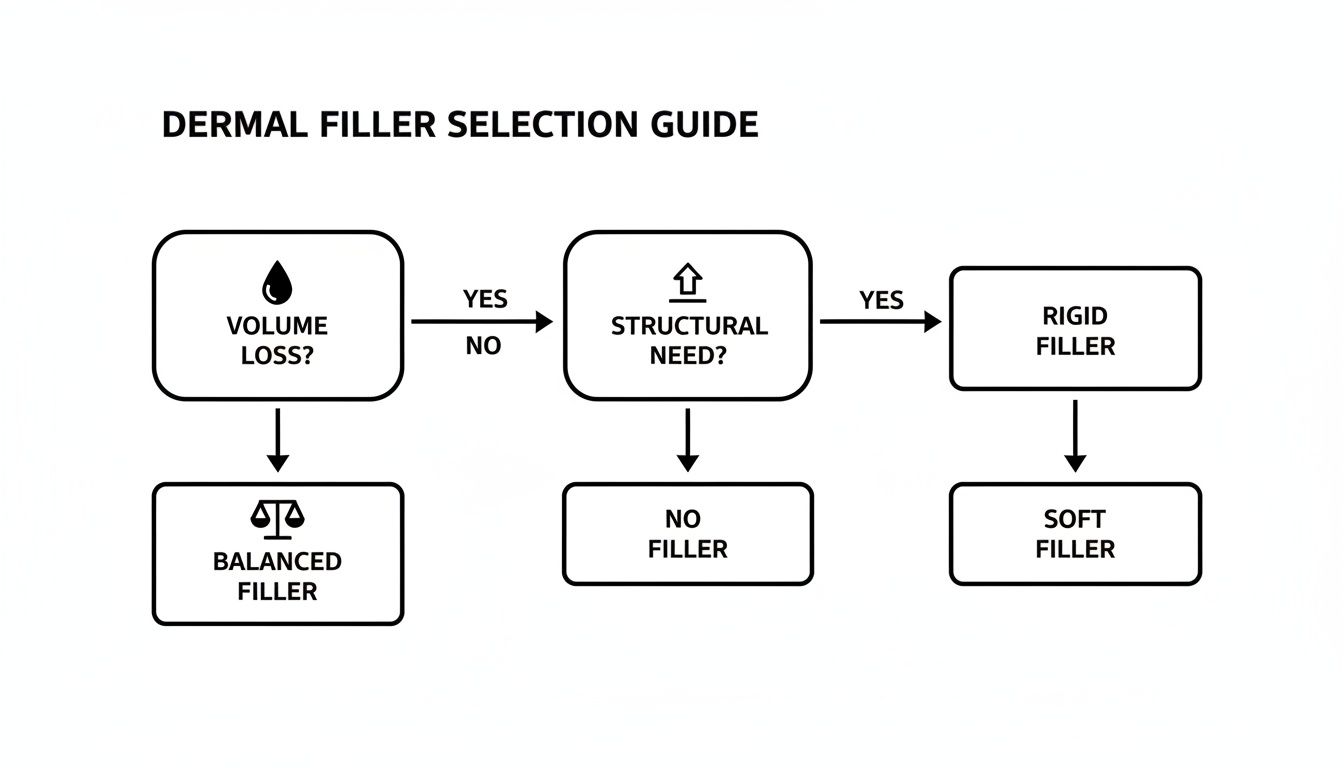
As you can see, for a complex area like the marionette lines, a balanced filler that can both lift and blend is often the sweet spot.
Restylane Defyne: The Flexible Supporter
On the other side, we have Restylane Defyne, which uses Galderma's XpresHAn Technology™. This is an innovative process that creates a gel that’s both strong and incredibly flexible. While Vollure is all about smoothness, Defyne is celebrated for providing serious structural support that still allows for a natural range of motion.
This makes Defyne an amazing option for deeper, more established marionette lines that need a bit more of a lift. It can effectively prop up the corners of the mouth and soften heavy folds without making you look unnatural when you express yourself. The gel is literally designed to stretch and recoil with your skin, which is exactly what you need in a high-movement area.
Key Takeaway: The decision often comes down to the depth and severity of your lines. Juvéderm Vollure acts like a smoothing filter, perfect for moderate lines that need soft integration. Restylane Defyne is more like flexible scaffolding, ideal for deeper lines that demand structural lift without stiffness.
Head-to-Head: A Quick Comparison
To really see how these fillers differ, it helps to put them side-by-side. I've created this table to highlight the key characteristics of each when we're talking specifically about treating marionette lines.
Comparison of Leading Fillers for Marionette Lines
Here’s a snapshot of how our two go-to fillers stack up for this specific concern.
| Filler Name | Key Technology | Best For | Flexibility & Feel | Typical Longevity |
|---|---|---|---|---|
| Juvéderm Vollure XC | Vycross Technology | Moderate lines needing a soft, seamless correction and natural movement. | Exceptionally smooth and pliable; integrates beautifully into the tissue. | Up to 18 months |
| Restylane Defyne | XpresHAn Technology™ | Deeper folds requiring structural support and lift with dynamic flexibility. | Supportive yet elastic; designed to stretch and move with expressions. | Up to 12 months |
This comparison shows there's no single "best" filler—only the best one for your unique anatomy and goals. While Vollure often lasts longer on paper, Defyne's structural support might be the more critical factor for someone with deeper lines.
Your Treatment Timeline: What to Expect and How Long Results Last
One of the biggest questions I get about fillers for marionette lines is, "How long will this actually last?" It's a great question, because you're not just investing money—you're investing time and trust.
The good news is that today's hyaluronic acid (HA) fillers are incredibly resilient, especially in the lower face. For those frustrating lines around the mouth, you can realistically expect your smoother, lifted results to last anywhere from 12 to 18 months. That’s a fantastic return from a single treatment session.
Factors That Influence Your Filler's Lifespan
While the 12 to 18-month window is a solid benchmark, it's not a one-size-fits-all number. Your unique body and habits play a huge role in how long your filler sticks around.
Here’s what we consider when mapping out your plan:
- Your Metabolism: Everyone’s body processes things at a different speed. If you have a naturally fast metabolism, you might find that your body breaks down the HA filler a bit quicker than someone with a slower metabolic rate. It’s just how you’re wired.
- Your Lifestyle: Are you an avid runner? Do you love spending time in the sun? Habits like high-intensity exercise, frequent sun exposure, and smoking can all speed up how quickly your body absorbs the filler.
- The Specific Filler We Choose: As we’ve covered, not all fillers are created equal. Formulations with more advanced cross-linking technology, like Juvéderm Vollure, are specifically engineered for better durability and will almost always outlast their softer counterparts.
I always tell my clients to think of filler not as a one-and-done fix, but as part of an ongoing beauty and wellness routine. Building a long-term relationship with your provider is the secret to getting and keeping results that always look incredible.
Understanding these factors helps us choose the perfect filler for you right from the start and plan your maintenance appointments intelligently. To get even more granular on this, check out our guide on how long dermal fillers last.
The Typical Treatment Journey
Your path to softening those marionette lines is straightforward and predictable. Knowing the steps ahead of time helps you feel confident and prepared.
It usually unfolds in three simple phases:
- The Initial Treatment: This is the main event! I’ll strategically place the filler to lift those corners and smooth out the lines. You’ll walk out of the clinic seeing a noticeable difference right away.
- The Follow-Up (2-4 Weeks Later): This check-in is so important. Once any minor swelling has completely vanished, we’ll take a look at the settled results. It’s our chance to make any tiny tweaks or touch-ups to ensure everything is perfect.
- Your Maintenance Plan: Before your results have a chance to fully fade, we’ll schedule your next appointment. This proactive approach keeps your look consistent and seamless, preventing those lines from ever fully returning.
This structured process ensures you get the absolute most out of your investment. And here’s some more good news: the marionette line area is known for holding onto filler incredibly well. This isn't just anecdotal—it's backed by solid research. Multicenter clinical trials have tracked HA fillers for up to 18 months and found that the success rate for treating marionette lines was as high as 88%.
These studies confirm that the kind of structurally supportive gels we use in the lower face have excellent longevity. You can read the full research on HA filler longevity if you're curious about the data. It’s powerful clinical evidence that reinforces why fillers are such a reliable and effective choice for this specific area.
Enhancing Your Results with Complementary Treatments
Dermal fillers are absolutely the gold standard for restoring lost volume in marionette lines. But if you want a truly comprehensive and lasting result, the smartest approach is multi-faceted. Think of filler as the essential foundation—it provides the lift and structure. Complementary treatments, both in-office and at-home, are the finishing touches that protect and elevate that foundation.
This kind of strategic layering doesn't just treat the symptom (the line itself); it addresses the underlying causes, like repetitive muscle movements and overall skin health. By combining treatments, you're creating a holistic plan for lower face rejuvenation that delivers incredible results for as long as possible.
The Power of Neuromodulators
One of the most effective partners for dermal fillers is a neuromodulator like Botox or Dysport. Marionette lines are often made worse by the constant downward tug of the Depressor Anguli Oris (DAO) muscles. These are the tiny muscles at the corners of your mouth that pull down when you frown, contributing to that perpetually sad or downturned expression.
A few carefully placed units of a neuromodulator can gently relax these specific muscles. The benefits are twofold:
- It stops the muscles from actively pulling down and deepening the marionette lines.
- It gives the corners of the mouth a subtle lift, restoring a more neutral, pleasant resting expression.
When used together, fillers replace lost volume while neuromodulators relax the dynamic pull that creates the crease. This powerful combination addresses the issue from two different angles, delivering a smoother, more natural, and longer-lasting outcome.
This combination is a cornerstone of advanced facial rejuvenation, as it tackles both static volume loss and dynamic muscle movement at the same time.
Supporting Your Investment with At-Home Care
What you do at home is just as critical as what happens in the clinic. Consistent, high-quality skincare isn't just about maintenance; it's about protecting your investment by boosting collagen and extending the life of your filler. This is where professional-grade tools can make a huge difference.
For maintaining vibrant, healthy skin, we strongly recommend incorporating a powerful at-home device like the Barb N.P. Facial Mask. This isn't just another gadget; it's a medical-grade tool designed to deliver professional-level results from the comfort of your home. Its thoughtful design is all about comfort and real efficacy.
The Barb N.P. Facial Mask stands out for a few key reasons:
- Comfort and Convenience: It’s completely wireless, so you can move around freely during your treatment. The mask is also crafted for a comfortable fit on your face, making it easy to build into your routine.
- Targeted Treatments: It comes with 3 lighting settings, each offering a specific therapeutic benefit to the skin.
This targeted approach lets you customize your treatments based on what your skin needs day-to-day, providing ongoing support that perfectly complements your in-office procedures.
Understanding the Barb N.P. Mask Settings
Each light setting on the mask works at a cellular level to improve skin quality, which directly supports the area treated with filler.
- Red Light: This setting is the ultimate collagen-booster. It penetrates deep into the skin to kickstart fibroblast activity, promoting the production of new collagen and elastin. This helps firm the skin and improve its underlying structure—vital for supporting fillers.
- Blue Light: Ideal for promoting clarity, blue light targets and eliminates acne-causing bacteria on the skin's surface. Keeping your skin clear and healthy ensures your filler results are the star of the show.
- Amber Light: This rejuvenating light works to reduce redness, calm inflammation, and improve lymphatic flow. It helps create a more even, radiant complexion overall.
Pairing the best dermal fillers for marionette lines with a neuromodulator and consistent at-home care using a device like the Barb N.P. Facial Mask is the ultimate strategy. It creates a 360-degree approach that restores volume, relaxes negative muscle pull, and continuously improves skin quality from the inside out.
How to Choose the Right Injector for Your Treatment

Picking the perfect dermal filler for your marionette lines is only half the story. The person holding the syringe is just as critical—if not more so. A truly beautiful outcome hinges on an injector who marries deep medical knowledge with a refined artistic eye.
Your provider’s command of facial anatomy doesn’t just keep you safe; it’s what delivers a natural, refreshed result instead of an obvious, “filled” look. This is why vetting your provider is the single most important decision you'll make in this process.
Look for credentials like a Nurse Practitioner (NP), Physician Assistant (PA), or a physician specializing in aesthetic medicine. Providers like Barb N.P. bring a wealth of medical training and years of hands-on experience, which means your treatment will be safe, effective, and perfectly suited to your unique features.
A great injector doesn't just fill lines. They see the whole picture—how your muscles move, how volume loss in your cheeks might be contributing to the lines around your mouth, and exactly where to place filler for a subtle lift that looks incredible from every angle.
Your Consultation Checklist
Walking into your consultation prepared is the best way to make sure you and your provider are on the same page. Having the right questions ready helps you evaluate their expertise and see if their approach is right for you.
Here are the non-negotiable questions to ask:
- Credentials and Experience: "What are your medical credentials? How long have you been injecting fillers, and do you have specific experience with marionette lines?"
- Product Recommendation: "Looking at my face, which filler do you recommend for me, and can you explain why you chose it over other options?"
- Technique and Placement: "What’s your injection strategy for this area? Will you use a cannula or a needle, and where will you place the product to get the result I want?"
- Portfolio Review: "Could I see some before-and-after photos of your actual patients who've had this treatment?"
The consultation is your chance to build trust. A skilled and caring provider will welcome your questions, give you straightforward answers, and ensure you feel completely confident in the plan before moving forward.
Pre and Post Treatment Care
Following the right prep and aftercare instructions is key to a smooth procedure, a fast recovery, and gorgeous, long-lasting results. Your injector will give you a specific list, but here are a few universal guidelines to keep in mind.
Before Your Appointment:
- For about a week beforehand, steer clear of blood-thinning medications and supplements like aspirin, ibuprofen, fish oil, and vitamin E to help minimize bruising.
- Avoid alcohol for at least 24 hours before your appointment.
- Show up with a fresh, clean face—no makeup, please!
After Your Treatment:
- For the first 24-48 hours, skip strenuous workouts, saunas, and intense sun or heat exposure.
- You can gently apply a cold compress to the area to help with any minor swelling.
- Don’t touch, rub, or massage the treated area for at least six hours. This lets the filler settle perfectly into place.
Following these simple steps helps make sure your recovery is a breeze and your results are everything you hoped for.
Your Marionette Line Filler Questions, Answered
Stepping into the world of dermal fillers for the first time always brings up questions. From how much product you'll need to what the recovery is really like, getting clear answers helps you move forward with total confidence.
Here are the answers to the most common questions I hear from my clients about treating marionette lines.
How Much Filler Is Needed for Marionette Lines?
This is never a one-size-fits-all answer. The amount of filler needed is completely personalized, depending on the depth of your lines and your unique facial structure. That said, most patients get a beautiful, natural-looking lift with 0.5 to 1.0 mL of filler per side.
A great injector always starts conservatively. It's far easier to add a touch more filler at a follow-up appointment than it is to dissolve it. This careful approach guarantees your results look refreshed and balanced, never overdone.
Is Getting Filler for Marionette Lines Painful?
Your comfort is my top priority. The good news is that most modern hyaluronic acid fillers, like those in the Juvéderm and Restylane families, are pre-mixed with lidocaine. This is a local anesthetic that numbs the area from the inside as I work.
Before we even begin, I'll apply a strong topical numbing cream to the area. Most of my clients report feeling just a slight, brief pinch or a bit of pressure. The entire experience is quick and very manageable.
Can Fillers in This Area Look Unnatural?
When performed by a skilled injector with an artistic eye, the results should be completely natural. The goal is never to erase every single line or create a puffy, frozen look. Instead, we want to gently soften the lines and restore the subtle volume your face has lost over time.
A skilled injector uses filler to rebuild soft, youthful contours in the lower face. The result is that you look rested and refreshed—not like you've had "work done."
This is precisely why choosing your provider is the most important decision you'll make. An expert injector knows exactly which product to select and uses advanced placement techniques to make sure the filler integrates seamlessly and moves naturally with every expression.
What Is the Recovery Time After Treatment?
Minimal downtime is one of the biggest perks of filler treatments. You can expect some mild swelling, redness, or bruising at the injection sites, but this is temporary and usually fades within a few days.
Most people feel comfortable returning to their normal activities right away. However, I always advise my clients to avoid strenuous exercise, saunas, and significant sun exposure for about 24-48 hours. This little bit of care allows the filler to settle in perfectly.
At Barb N.P., I believe in pairing expert in-office treatments with powerful at-home care. To maintain and boost your filler results, consider the Barb N.P. Facial Mask, a medical-grade LED device that supports collagen production and overall skin health. You can learn more about my services and curated products at https://barbnp.shop.