
Posted by Barb N.P. Team
on December 01, 2025

So, you’ve gotten an allergy test, and the results are in. But what do they actually mean? When someone asks, "how accurate are allergy tests," the honest answer isn't a simple yes or no. The truth is, their reliability is a puzzle, with pieces like the specific test used, the allergen in question, and your own unique health story all playing a part.
Here’s the most important thing to know upfront: a positive test result shows your body is sensitized to something. But that is not the same as having a true, clinical allergy.
Decoding What Your Allergy Test Results Really Mean
If you’ve ever gotten a positive test for a food you eat all the time with zero issues, you've stumbled upon the biggest misconception in allergy testing. Your test results are a critical clue, but they don't tell the whole story on their own.
Think of a positive test like a smoke alarm. It's designed to be highly sensitive to potential danger (an allergen), but sometimes it goes off for something totally harmless, like a little burnt toast. It gets your attention, but it doesn't automatically mean the house is on fire.
This is why an allergist never looks at test results in a vacuum. They combine that data with your detailed medical history and the symptoms you’re actually experiencing to build a complete and accurate picture.
This diagram perfectly illustrates the critical difference between being sensitized and having a true allergy.

As you can see, your immune system can recognize a substance (sensitization) without ever triggering the hives, sneezing, or stomach upset that defines an actual allergy.
Key Concepts: Sensitivity and Specificity
To really get a handle on allergy test accuracy, we need to talk about two key terms from the world of medical testing: sensitivity and specificity. Don't worry, it's simpler than it sounds.
- Sensitivity: This is a test's ability to correctly find people who do have an allergy. A test with high sensitivity is great at sniffing out potential culprits. If a highly sensitive test comes back negative, you can be pretty confident you're in the clear.
- Specificity: This is a test's ability to correctly identify people who do not have an allergy. A test with high specificity is great at confirming a suspicion. If you test positive on a highly specific test, it's very likely you are truly sensitized.
The catch? No single test is 100% perfect at both. Some are better at confirming an allergy, while others are better at ruling one out. This is exactly why allergists often use a combination of tests alongside a thorough clinical evaluation. For anyone especially concerned about diet-related reactions, it’s worth diving deeper into the specifics of food sensitivity testing accuracy to understand the nuances.
The big takeaway here is that allergy tests are diagnostic tools, not definitive judgments. A positive result is the starting point for a conversation with your healthcare provider, not a final verdict on what you have to avoid for the rest of your life.
The goal is always to use this information to make smart decisions that improve your quality of life—not to create a long list of unnecessary restrictions based on a single lab number. Working with an expert ensures your results are put into the right context, leading to a management plan that is both safe and practical for you.
Decoding Skin Prick Tests
When you ask, "how accurate are allergy tests?" the conversation almost always starts with the Skin Prick Test (SPT). For decades, it's been the allergist's go-to for diagnosing allergies to things like pollen, pet dander, and mold—and for good reason. The process is surprisingly simple but incredibly telling.
An allergist places a tiny drop of liquid containing a potential allergen on your skin, usually your forearm or back. Then, they use a tiny, sterile probe to gently prick the surface. It's not a shot; it feels more like a light scratch.
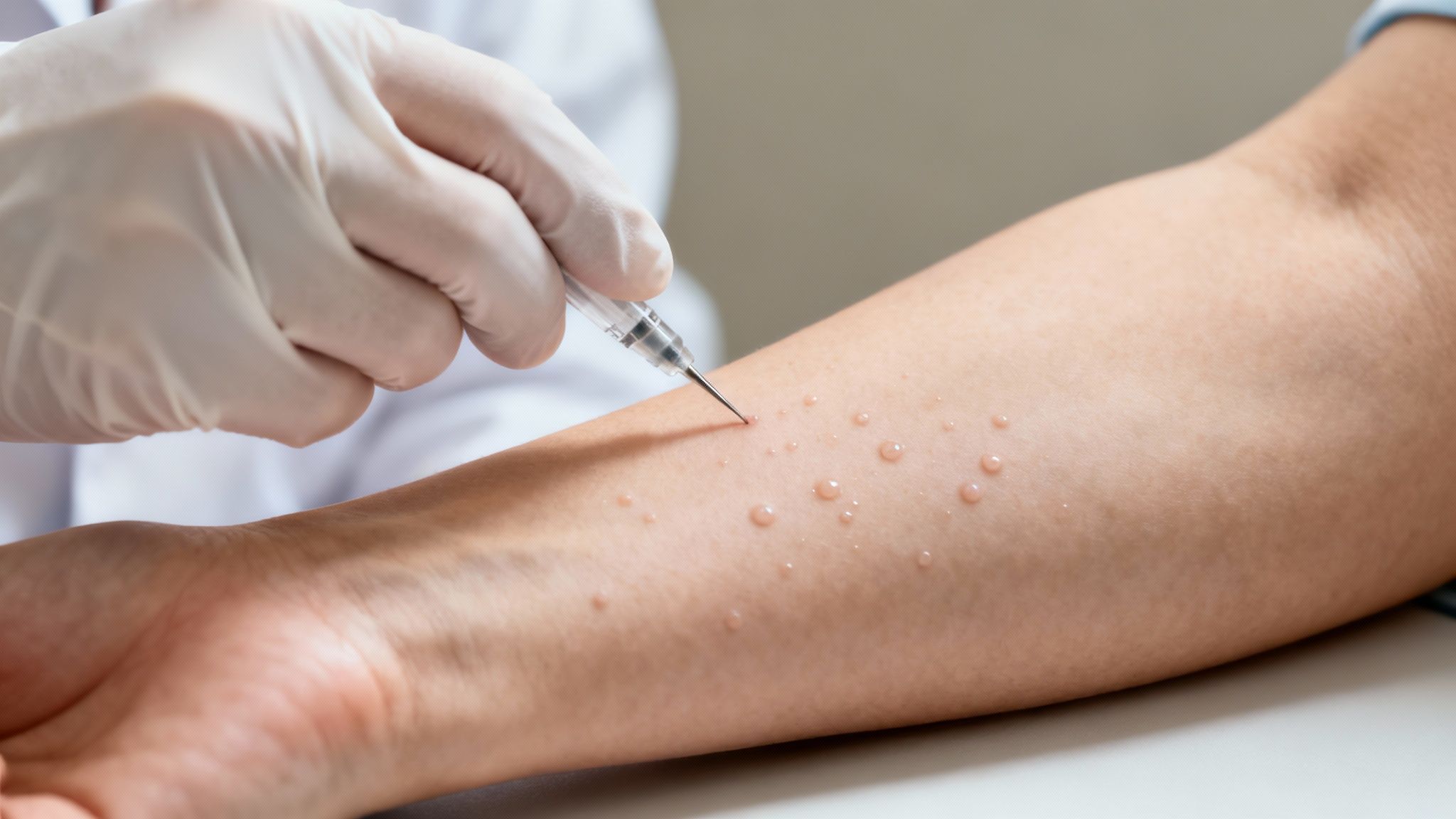
You’ll wait about 15 to 20 minutes, and then the allergist will check for a reaction. A positive result looks like a small, raised, reddish bump—called a wheal—that resembles a mosquito bite. The size of that bump gives clues about how sensitized your body is to that substance.
Why Skin Prick Tests Are So Highly Valued
The SPT is a cornerstone in allergy diagnosis because it offers a few key advantages that make it the preferred starting point for most allergists.
- Fast Answers: Forget waiting days for lab results. With an SPT, you get answers in minutes, so you can have a meaningful conversation with your doctor right away.
- High Sensitivity: These tests are fantastic at detecting IgE antibodies on your skin's mast cells, making them highly effective at flagging potential triggers.
- Cost-Effective: They’re typically less expensive than blood tests, especially when you need to check for a whole panel of allergens at once.
But here’s the crucial part: a positive skin test identifies sensitization, not necessarily a clinical allergy. It confirms your immune system has created antibodies against something, but it doesn't guarantee you'll sneeze or break out in hives when you're exposed. This is why a good allergist always interprets the results alongside your personal medical history.
A positive skin prick test is a strong clue, but your symptom history is the other half of the equation. An allergist connects these two pieces to make an accurate diagnosis, ensuring you don't avoid things unnecessarily.
Think of it this way: you might test positive for cat dander but live happily with your feline friend without a single sniffle. In that scenario, your immune system is sensitized but tolerant.
The Power of a Negative Result
One of the most valuable features of the skin prick test is its powerful negative predictive value. What does that mean? If an SPT comes back negative for a certain allergen, you can be extremely confident that you are not allergic to it. This provides incredible peace of mind and prevents you from needlessly avoiding foods, pets, or environments.
This reliability is a game-changer when it comes to potential drug allergies. Many people think they're allergic to penicillin because of a childhood rash, but a negative skin test can often rule this out safely. For penicillin, a negative skin test has a 95% to 98% negative predictive value for preventing severe reactions, offering a solid way to clarify a patient's allergy status. You can learn more about the reliability of skin testing from the American Academy of Family Physicians. This level of accuracy helps doctors make confident prescription decisions and helps you avoid unnecessary restrictions in your life.
Understanding Allergy Blood Test Results
While a skin prick test is often the first thing that comes to mind for allergy testing, it’s not the right fit for everyone. If you have a significant skin condition like eczema or psoriasis, or if you can’t safely stop taking antihistamines for a few days, a skin test just isn't practical.
This is where allergy blood tests come in. Instead of reacting on your skin, the test happens in a lab, measuring specific IgE (sIgE) antibodies in a small sample of your blood.
Think of it as an internal investigation. Your blood holds a record of every substance your immune system has flagged as a potential enemy. The sIgE test simply reads that record, showing us which "wanted posters" (the IgE antibodies) your body has created.
It's crucial to understand that a high IgE level indicates sensitization, not a guaranteed allergy. It means your body is primed to react, but it doesn't confirm you'll actually experience symptoms like hives, sneezing, or worse upon exposure.
Weighing the Pros and Cons
Like any diagnostic tool, blood tests have their own set of strengths and weaknesses. Knowing when to use them is key to understanding how accurate allergy tests are.
Why Blood Tests Are a Great Option:
- Convenience: It’s just one needle prick. For anyone anxious about the multiple scratches of a skin test, this is a much more comfortable experience.
- No Medication Interference: You don't have to stop taking your daily antihistamines or other medications, which is a huge plus for those who rely on them to function.
- Safety for High-Risk Patients: For anyone with a history of severe anaphylaxis or highly reactive skin, a blood test is a much safer route, as there's zero risk of triggering a reaction.
But there are a few trade-offs. Blood tests are generally considered a bit less sensitive than skin prick tests, which means they might occasionally miss a true sensitization. The results also take longer—usually a few days to a week—and the cost can be higher.
The Lab You Choose Matters
One of the most important factors influencing your results is the quality of the lab doing the analysis. Different labs use slightly different methods and equipment, which can lead to variations in the data.
To get the most dependable results, it's vital to ensure your sample is processed by a certified, reputable laboratory.
The accuracy of allergy blood tests is well-established. Studies show their ability to correctly identify a sensitivity ranges from 70% to 90%, while their ability to correctly rule one out (specificity) is between 40% and 100%, depending on the specific allergen and the lab performing the test.
For a deeper dive into how to understand blood test results from a broader health perspective, this guide is a fantastic resource.
Ultimately, these tests give us valuable, concrete numbers. When we pair that data with your personal symptom history, we can build a complete and accurate diagnostic picture. If the convenience of this method appeals to you, exploring options for allergy testing at home could be a great next step.
Exploring Advanced Allergy Diagnostics
Sometimes, the standard skin and blood tests give us clues, but they don’t tell the whole story. When results are murky or we need to dig deeper to understand your real-world risk, allergists bring out the heavy hitters: more advanced diagnostic methods. These tools are designed to solve the most complex allergy puzzles, bringing clarity where there was once confusion.
One of the most powerful of these is Component-Resolved Diagnostics (CRD). This isn’t your average allergy blood test. Think of it as a high-definition analysis that identifies the specific proteins within an allergen that are setting off your immune system.

Here’s a simple way to look at it: a standard blood test sees a “peanut” as one single thing. CRD, on the other hand, breaks that peanut down into its individual protein building blocks, like Ara h 2 or Ara h 8. And that distinction is a game-changer.
Pinpointing the Real Culprits
So, why does getting down to the protein level matter so much? Because not all allergen proteins are created equal. Some, like Ara h 2 in peanuts, are the real troublemakers—they’re strongly linked to severe, systemic reactions like anaphylaxis.
Others, like Ara h 8, are more likely to cause milder, localized symptoms like an itchy mouth. This is often due to cross-reactivity with things like birch pollen.
By pinpointing the exact protein your body is sensitized to, CRD helps an allergist:
- Assess Your True Risk: It helps differentiate between a high-risk allergy needing strict avoidance and a lower-risk sensitivity that might not be as dangerous.
- Explain Cross-Reactivity: It can finally explain why you get an itchy mouth from apples if you have a birch pollen allergy—they share structurally similar proteins.
- Refine Dietary Guidance: In some cases, it can open the door to safely eating certain forms of an allergen, like baked milk or eggs when the raw forms cause a reaction.
Component-resolved diagnostics have become an indispensable tool for getting food allergy diagnoses right. While research shows CRD is quite sensitive, its specificity can sometimes be imperfect. You can read the full research about these diagnostic findings if you're curious about the science. This is why even these sophisticated tests are always interpreted alongside your personal medical history.
The Oral Food Challenge: The Gold Standard
When all other tests—skin, blood, and even component—still leave lingering questions, there’s one definitive way to confirm or rule out a food allergy: the Oral Food Challenge (OFC). This is widely considered the “gold standard” because it directly answers the ultimate question: Will you actually react if you eat this food?
An OFC is serious business. It’s always done under strict medical supervision in a clinic or hospital where emergency equipment and trained staff are immediately available.
The process is slow, careful, and methodical:
- You start by eating a tiny, precisely measured amount of the food in question.
- You’re then observed for 15-30 minutes. If there are no signs of a reaction, you’re given a slightly larger dose.
- This step-by-step process of gradually increasing the dose continues for several hours until you’ve eaten a full, normal serving of the food.
Throughout the entire challenge, you are monitored constantly by medical professionals for any sign of an allergic reaction, from mild hives to more severe symptoms.
An oral food challenge provides the most accurate and conclusive evidence of a food allergy. It moves beyond just showing sensitization to confirm a true clinical allergy based on real-world exposure in a controlled, safe environment.
Because an OFC involves deliberately eating a potential allergen, it carries a real risk of triggering a reaction. For that reason, it’s reserved for very specific situations where the benefit of getting a clear-cut answer outweighs the risks. It’s a time-consuming and intensive process, but for many families, the peace of mind that comes from a definitive yes or no is absolutely invaluable.
Common Factors That Influence Test Results
An allergy test result can feel like a final, definitive answer, but the size of a skin wheal or a number on a lab report doesn't tell the whole story. Think of these tests as a snapshot in time. Several crucial factors can act like background noise, interfering with the clear signal we’re looking for.
Understanding what can sway your results is the key to having a truly productive conversation with your doctor. It empowers you to see your results not as a simple yes or no, but as one piece of a much larger puzzle.
The Impact of Medications
This is one of the biggest and most common culprits. Certain medications, especially antihistamines, can dramatically throw off the accuracy of a skin prick test. Their entire job is to block the very histamine reaction that the test is designed to trigger!
Taking something like Zyrtec, Claritin, or even Benadryl within a few days of your skin test is a recipe for a false negative. Your body might genuinely be allergic to a substance, but the medication completely silences the alarm bells, preventing the tell-tale red bump from ever appearing.
It's absolutely critical to give your allergist a complete list of every single thing you're taking—prescriptions, over-the-counter drugs, and even herbal supplements. They'll give you clear instructions on what to stop and for how long to ensure your results are actually reliable.
Timing and Recent Exposure
When you get tested matters almost as much as how you get tested. If you get tested too soon after a major allergic reaction, your immune system can enter a temporary "refractory period" where it simply won't react again for a short while. This can lead to another frustrating false negative.
On the flip side, getting tested for pollen allergies in the middle of peak season when your system is already on high alert might produce more dramatic results. This doesn’t make the test wrong, but it adds important context that your allergist will use alongside your symptom history to make an accurate diagnosis.
Cross-Reactivity: The Immune System Mix-Up
Here’s where things get really fascinating—and sometimes confusing. Cross-reactivity is a case of mistaken identity on a molecular level. It happens when your immune system gets its wires crossed, reacting to a protein in one substance because it looks incredibly similar to a protein in something you're truly allergic to.
The classic example of this is Oral Allergy Syndrome (OAS). If you have a known birch pollen allergy, you might find your mouth gets itchy after eating a raw apple, celery, or carrot. This isn't a true apple allergy; it's your immune system seeing a protein in the apple, mistaking it for birch pollen, and launching an attack.
- Birch Pollen: Can cross-react with apples, almonds, carrots, celery, and peaches.
- Ragweed Pollen: May cross-react with bananas, melons (like cantaloupe and watermelon), and zucchini.
- Latex: Often cross-reacts with foods like avocado, banana, kiwi, and chestnut.
Understanding this is so important because a positive test to a specific food might just be an echo of a primary environmental allergy. Sometimes these ideas can get tangled up with other conditions. To get a better handle on it, you can explore the difference between a food intolerance and an allergy in our other guide. Working with an expert helps untangle these tricky connections, preventing you from cutting foods out of your diet unnecessarily.
How to Calm Your Skin After the Test
It's completely normal for your skin to look a little red, bumpy, or feel itchy where the skin prick test was done. Think of it as your body's way of talking—and a sign the test is working. While the reaction will fade on its own, a little aftercare goes a long way to keep you comfortable and help your skin bounce back quickly.
For anyone looking to soothe irritation and build long-term skin resilience, we recommend the Barb N.P. LED Facial Mask. It’s a gentle, non-invasive way to calm inflammation without layering on heavy creams. Plus, its wireless, ergonomic design fits snugly and lets you move around freely while you treat your skin.
Speed Up Recovery and Build Healthier Skin
The Barb N.P. mask is armed with three therapeutic light settings, each with a specific job. After a procedure like a skin test, the red light setting is your best friend. It helps dial down inflammation and boosts circulation, which is exactly what you need to soothe redness and get your skin back to baseline.
But its benefits go far beyond just post-procedure care, especially for those with sensitive, reactive skin:
- Red Light Therapy: Calms inflammation and jump-starts collagen production. Over time, this helps strengthen your skin’s protective barrier.
- Blue Light Therapy: Zaps surface-level bacteria, which is a huge plus for preventing breakouts when your skin is already feeling reactive.
- Amber Light Therapy: Works on reducing overall redness and improving skin tone, leaving you with a more even, calm complexion.
A strong, healthy skin barrier is your first line of defense against all sorts of sensitivities. Whether you're dealing with irritation from a procedure, environmental triggers, or an underlying allergy, a resilient barrier makes all the difference.
By making this part of your regular routine, you’re not just treating temporary irritation—you’re proactively building skin that’s less reactive and better prepared to handle stressors. It’s the perfect complement to understanding your body’s sensitivities, ensuring you feel as good on the outside as you do on the inside.
Still Have Questions About Allergy Test Accuracy? Let's Clear Them Up.
Even after digging into the science, it's totally normal to have a few lingering questions. The world of allergy diagnostics can feel a bit murky, and getting clear, straightforward answers is the key to feeling confident about your health. Let’s tackle some of the most common questions that come up.
"My Test Was Negative, but I Swear I'm Allergic. Is That Possible?"
Yes, absolutely. This is what we call a false negative, and it can happen for a few reasons. If you popped an antihistamine before your skin prick test, for instance, it could have completely blocked the reaction your body was supposed to have. Testing too soon after a major allergic event can also, surprisingly, give you a negative result.
Beyond that, some allergies are non-IgE mediated, meaning the standard tests we’ve discussed simply aren't designed to find them. This is exactly why your personal history—your story—is so critical. If you get the same symptoms every single time you’re exposed to a trigger, an allergist will likely want to investigate further, maybe even with an oral food challenge, no matter what the initial test says.
"Why Did I Test Positive for a Food I Eat All the Time With No Problems?"
This is the perfect real-world example of sensitization versus a true clinical allergy. A positive test doesn't automatically mean you're allergic; it just shows your immune system has created IgE antibodies against that substance. That's sensitization.
If you eat that food without any issues, you're considered tolerant, and you're not truly allergic. In almost every case like this, your allergist will tell you to keep eating that food to maintain your body's tolerance. One of the biggest mistakes people make is cutting out foods based only on a test result, which can lead to a really restrictive and unnecessary diet.
For anyone dealing with tricky skin reactions, getting these results right is invaluable for figuring out what’s causing issues like chronic hives. To learn more about that, this guide on identifying and treating hives is a fantastic resource.
"How Often Should I Get Retested for Allergies?"
There’s no one-size-fits-all answer here; it’s highly individual. For kids, who often outgrow allergies to things like milk, eggs, or wheat, an allergist might suggest re-evaluating every one to three years to see if things have changed.
On the other hand, allergies to peanuts, tree nuts, or shellfish are usually for life. For those, or for persistent environmental allergies, retesting is done much less often. It typically only happens if there’s a major shift in your symptoms or your treatment plan needs an update. The best approach is always to follow your allergist's specific guidance for a schedule that makes sense for you.
At BotoxBarb, we believe knowledge is power, especially when it comes to your health and well-being. From demystifying complex test results to offering solutions that build your skin's resilience, our mission is to help you feel confident, inside and out. You can explore our curated wellness products at https://barbnp.shop.